

In continuum: Interview with Fernando Viegas
FERNANDO VIEGAS
“Building requires a lot of energy and changes in matter. It requires reasoning from time cycles.”
FERNANDO VIEGAS
“Building requires a lot of energy and changes in matter. It requires reasoning from time cycles.”
RICARDO CARVALHO
“For a few years, less than ten, I believe, half of the planet’s population was urban, so its analysis is both quantitative and on meaning. “
TOM EMERSON
“I think that the big paradigm shift is that we need to be really much more focused around the notion of the existing and how that can be reinvented and given a proper future, and that’s different, that’s a kind of a next stage in industrialisation.”
DUARTE BELO
“As if I were on the ground, climbing a mountain. I reach the top and observe the landscape. I then define my way down. This way, I walk through the entire history of human settlement.”
INÊS LOBO | RITA AGUIAR RODRIGUES
“If architecture can be understood as a discipline that operates on time, perhaps the contemporary challenge does not lie in choosing between transformation and continuity, but in coming to understand them once again as inseparable parts of the same process.”
ALEXANDRA CASIMIRO
“This research presents an analysis of the Palácio da Justiça project (1970) in Lisbon, from the scale of the city to the scale of the doorknob, in reference to the expression “from the Spoon to the City.”
THAIS ANASTÁCIO
“On the cliffs of Madeira Island, the landscape imposes a rare type of attention: Resilience. This is the case of the Salinas Swimming Pools in Câmara dos Lobos, inaugurated in 2006.”
JOÃO MIRANDA
“Through drawing, writing, and observation, Siza seeks to understand the specific conditions of the territory, transforming direct experience into a conceptual structure capable of guiding the development of the project”
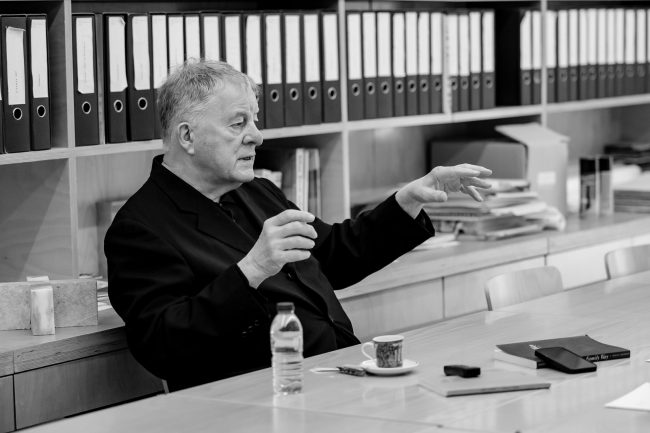
“I once believed that if I created architecture that spoke to people, they would naturally understand it. But they do not and that realisation has been revealing for me.”
MADALENA MIRA
“The Analytical Description of the Execution of the Equestrian Statue, published by Joaquim Machado dVVe Castro in 1810, is a rare and highly significant document within both Portuguese and European artistic contexts.”