

Sofia Pinto Basto
sofiapintobasto@hotmail.com
Architect and PhD candidate at the Department of Architecture of the Autonomous University of Lisbon (Da/UAL), Portugal. CEACT/UAL – Centre for Architecture, City and Territory Studies of the Autonomous University of Lisbon, Portugal
TO cite this article:
BASTO, Sofia Pinto – City and Democracy. Weak Thought: Egle Trincanato. Venezia Minore and the INAIL Headquarters in Venice. Estudo Prévio 25. Lisbon: CEACT/UAL – Centre for Architecture, City and Territory Studies of the Autonomous University of Lisbon, December 2024, p. 109-134. ISSN: 2182-4339 [Available at: www.estudoprevio.net]. DOI: https://doi.org/10.26619/2182-4339/25.24
Received on July 31, 2024, and accepted for publication on October 21, 2024.Creative Commons, licença CC BY-4.0: https://creativecommons.org/licenses/by/4.0/
Weak Modernity: Egle Trincanato. Venezia Minore and the INAIL Headquarters in Venice
Abstract
Egle Renata Trincanato (1910-1998), the first architect to graduate from the School of Venice, developed an extensive academic, institutional, and theoretical career alongside a design practice situated between the language of modern architecture and its integration into the urban and historical context of Venice. Her close knowledge of the city, explored in her book Venezia Minore, and her commitment to the principles of the modern movement, are evident in her design for the INAIL Headquarters in Venice.
This analysis of the relationship between theory and practice draws on the concept of “weak thought”, as articulated in 1983 by Gianni Vattimo (1936-2023), and seeks to present a historiographical approach in the field of Architecture, not confined to the canonical currents of the 20th century but revisited through its weak deviations.
By briefly describing the cultural and artistic environment in Italy from the 1930s to the 1960s, this study aims to contextualize Trincanato’s work within the broader debate of the century: the continuity of history versus the rupture proposed by the modern movement. In this controversy, the dominant discourse (modernism, rationalism, monumentality) is continuously re-examined and confronted. With the decline of the fascist regime, an alternative narrative emerges, rooted in vernacular architecture, impure knowledge, and particular circumstances (vernacular drift, neorealism). In this critical re-evaluation, the discourse of modernity gains complexity and depth.
In this context, and by relating Egle Trincanato’s study of Venezia Minore to her design for the INAIL Headquarters, we conclude that, as an alternative to the failure of strong ideologies, Trincanato presents a knowledge of fragility and proximity. As a counterpoint to the dogmas of modernism, Trincanato undertakes a critical action of contextualization in the place, elevating minor architecture as a form of resistance. The city, in the strength of its weak forms, becomes the mediating organism that deforms and revisits modernity.
Keywords: Weak Thought, Rethinking History, Modernism, Minor Architecture, City, Venice
Introduction
Egle Renata Trincanato (1910-1998) [1], was the first female architect to graduate from the Venice School of Architecture. She developed a vast body of work situated between the principles of modern architecture and its integration into the urban and historical context of Venice. Her profound knowledge of Venice, highlighted in the theoretical research of Venezia Minore (Trincanato, 1948), significantly informed her design practice. The project for the INAIL headquarters (Istituto Nazionale per l’Assicurazione contro gli Infortuni sul Lavoro), developed in collaboration with Giuseppe Samonà, reflects the substantial transformation of modernist and rationalist discourse when it engaged with the Venetian urban environment.
Her academic, institutional, practical, and critical journey consistently intersected with key figures of modernism, in particular Giuseppe Samonà (1898–1983), with whom she had an ongoing collaboration. The donation of her private archive to IUAV in 2004 and the subsequent reorganization and assessment of this collection, accompanied by an exhibition at the Querini Stampalia Foundation in 2008 [2],
have enabled a deeper understanding of the breadth and diversity of her work. Her oeuvre has become the subject of extensive research, generating articles, seminars, and publications. Initially confined to a university and regional context, this scholarship has progressively gained broader dissemination.
The aim here is not to reconstruct a biography but rather to establish a connection between Trincanato’s theoretical and design practices as an example of “fragile modernity.” This concept reflects a departure from the rigid ideological principles of Modernism shaped by interactions with specific cultural ecosystems. Here, fragility does not signify weakness but rather resilience, embodied in a plastic, non-prescriptive yet transformative and multifaceted adaptation of the dogmas of the modern movement.
This analogy draws on the concept of “weak thought” [3], articulated by Gianni Vattimo (1936–2023), and works as an attempt to reinterpret Trincanato’s work through this lens. Within this conceptual framework, using notions such as fragments, micrology, traces, everyday life, temporality, or dissolution (Vattimo, 1983). The article defends a rejection of a singular historiographical narrative. Instead, embracing a narrative of fragmentation, expanding the collective consciousness and broadening the scope of interpretation. The proposal to revise the seemingly stabilized canon allows for a reading of the margins within a grand, univocal narrative.
In the field of Architecture, the Trincanato case is presented as a re-imagining of the modern movement—a “weak” deviation shaped by its proximity to the Venetian context, minor architecture, and the ordinary urban fabric.
The Venezia Minore study, rooted in the subtle and often overlooked forms of the city’s fabric, is the result of meticulous observation and immersion in everyday life. It seeks to uncover the hidden alphabet within commonplace typologies. It is a weak thought that suspends a strong one—a reflection on the codes of modernism. This tension disrupts the central architectural discourse of modernity by drawing on the study of Venetian vernacular forms and adapting them from a critical perspective. This shift is evident in the INAIL project and, within this theoretical framework, reflects a “weak” fragmentation of the strong discourse of modernity and rationalism.
The proposal is to analyse this example within the Italian cultural ecosystem, and to briefly outline the period of decline of the fascist regime. During this time, the dictatorship’s imposed optimism with regard to the future clashed with the resistance of History and local contexts. This gave rise to continuous transformations in architectural trends (modernism, rationalism, monumentality). The use of Architecture as a means of power—imposing and autocratic—under Benito Mussolini (1883–1945) came into conflict with resistance narratives, such as the vernacular drift in architecture or neorealism in cinema. Amid this ferment of opposing principles and cross-contaminations, Trincanato offers a layering of strong and “weak” narratives, simultaneously acknowledging and applying modernist codes while embracing a hybrid position that deviates from the canon.
In this context, the INAIL headquarters project strikes a balance between modernist/rationalist tendencies and the vernacular resistance outlined in Venezia Minore, combining transformative action and continuity. The fragmentation and atmosphere of Venice’s historical fabric serve as a force that resists the innovative impulse of its modernist design.
Through its minor forms, its everyday life and in its proximity, the city becomes an entity that deviates from and reinterprets the canon and strong thought. The invisible fragility forms a structured, elastic, and continuous organism. This resilience of the fragment leads to a constant critical updating of the premises and codes of modernity’s strong thought. Confronted with different contexts, it expands its possibilities, transforming the discourse and, through the “weak” heresy, carrying forward the modernist legacy.

Figure 1 – INAIL headquarters, Venice. Casabella, 1960 (Photograph by Paolo Monti, Ferruzzi, Egle Trincanato, c.1960. Source: Casabella, no. 244. Available at: https://casabellaweb.eu/the-magazine/yearannata-1960-xxiv/).
1. History

Figure 2 – Walter Benjamin ( Available at; Civil-society-fascism & the death of Walter Benjamin – Historical Materialism). Figure 3 – Angelus Novus, Paul Klee, 1920. ( Available at: https://www.wikiart.org/fr/paul-klee/angelus-novus-1920). Figure 4 – Il Pensiero Debole, Gianni Vattimo, 1992 (1st ed. 1983).
“There is a painting by Klee entitled Angelus Novus. An angel is depicted there who looks as though he were about to distance himself from something which he is staring at. His eyes are opened wide, his mouth stands open and his wings are outstretched. The Angel of History must look just so. His face is turned towards the past. Where we see the appearance of a chain of events, he sees one single catastrophe, which unceasingly piles rubble on top of rubble and hurls it before his feet. He would like to stop to awaken the dead and reconstruct, from the fragments, what has been destroyed. But from paradise blows a storm that coils around his wings, and it is so strong that the angel can no longer close them. This storm irresistibly drags him toward the future, which he turns his back on, while the heap of ruins in front of him grows sky-high. What we call progress is this storm.” (BENJAMIN, 2010: 13)
Walter Benjamin (1892-1940), writing about the drawing by Paul Klee (1879-1940), Angelus Novus (1920), questions the concept of History and progress. History unfolds as a powerful, unbroken, linear current, flowing over a heap of ruins and fragments.
For Benjamin, in 1940, in the era of Europe’s destruction, during the resistance to fascism, and on the eve of his own suicide, History required a profound revision. Historicism, with its linear and redemptive vision, marching towards unquestionable progress, overlooks the state of exception, where life unfolds, feeding into the current of the victors and, ultimately, the rise of fascism. Benjamin’s text announces the bankruptcy of ideologies, the failure of prophetic visions, and the need for new foundations on which to establish a new order. It is a rejection of the dominant discourse, that of the strong authority of autocratic regimes which had torn the world apart in extreme conflict. It is from this turbulent place, from these fragments, that History ought to be told.
From this fragmented flow of the real, we choose, relate, and form a horizon from which we seek to recognize ourselves. We write History to free ourselves from the inevitability of our own disappearance.
The selection of facts that inform the collective historiographical body is based on the idea of a certain objectivity, valuing events whose impact is, from our perspective, significant. This selection of events will become the narrative that will be fixed for the future as the historical canon of a culture.
The construction of History and the tension between its necessity and excess was a central debate of the twentieth century, pitting the values of the avant-garde against the resistance of the past and tradition in a desire for the future that clashed with an unavoidable nostalgia for loss. Distinct ideologies become central axes that replace each other.
In the 1980s, Gianni Vattimo proposed a new way of interpreting history, not as a series of strong narratives that succeed and surpass each other, but rather as a fragmented, deviant, declining, and multi-faceted framework. This is the proposal he defends in his article “Weak Thought”. In this 1983 text, Vattimo suggests re-reading a century marked by the rise of autocratic regimes, world conflicts, the decline of ideologies, and a cultural context that seeks to integrate, influence, or resist the successive historical upheavals.
Vattimo challenges the construction of a single History as a continuous, linear, and deductive time. Following in Benjamin’s footsteps, History, as a narrative written by strong thought, as a homogeneous progress, should be revised in favour of a fragmented, heterogeneous, multiple whole—a weak thought. This implies shattering History into deviations, declinations, traces that never made it into the historiographical canon: “the heritage passed down to us does not constitute a unitary whole, but a dense network of interferences, traces that did not become the world: the ruins accumulated by the History of the victors at the feet of Klee’s angel”. (VATTIMO, 1992: 27)
Vattimo establishes the idea of weak thought, announcing it as the opening of cracks in the stability of a central matrix, reversing the tradition of continuous overcoming. This modality opens up the possibility of non-canonical alternatives, contaminations, and overlaps.
In the field of Architecture, the twentieth century establishes its strong canon based on continuity or rupture with the modern movement. We question whether we are modern, postmodern, anti-modern, or if we have never been modern, seeking to rewrite History in its critical relationship with this central discourse. These discourses delve into contradictory drifts that strive to surpass themselves, either by revisiting the original codes of modernism, idealizing them or liberating themselves from them, announcing the demise of their most utopian expectations. The counter-discourses of historiography are aspects of our ongoing dialectic with modernity.
In this article, weak thought is proposed as an analogy and interpretative lens. By analysing a specific case, we associate strong thought with the modern movement stabilized by the historiography of the discipline. Modernist ideals, the machine for living, and the radiant city, appear effective and replicable. Throughout the century, these dogmas, with their imposing discourse, were consistently embraced by the avant-garde and autocratic ideologies, either as a celebration of change or as a manifestation of the dominators’ power.
Weak thought, as a category for reading this canon, allows for the acceptance of an impure form, marked by contextualized bonds of belonging that, while not negating the modern paradigm, do not fully replicate its pattern. Weak thought does not impose a constant substitution of frameworks but rather an approximation, a contamination, a dissolution. It is within this possibility, the overlapping of discourses, that the work of Egle Trincanato will be presented.
2. Historical and cultural horizon
2.1 Totality and Overcoming. Rhetorics of Power: Rationalism and Monumentality
“For about a generation, from 1920 to 1955, the role of the historian in architectural didactics was similar to that of the pathetic proposer of a toast. Their task was to offer a more or less awkward homage to a cultural continuity now disconnected from what architecture considered its authentic mission. This mission, as proclaimed by the masters of modern architecture in the 1920s, consisted of starting everything from scratch. The muse of Gropius, Mies van der Rohe, Le Corbusier, Aalto, Oud, and dozens of others did not admit illicit affairs with History.” (MOHOLY- NAGY, 1988: 32)
Sybil Moholy-Nagy’s (1903-1971) comment reveals the difficulty and ambivalence faced by modern architecture, from the very beginning, in its relationship with tradition. In the glorification of a new reality, in the foundation of an inaugural and forthcoming world, any bond with the past was “a cause for embarrassment.”
The Italian context, in its search for a national identity for a recently consolidated nation, had been marked by this confrontation since the beginning of the century. The Futurist drift, as expressed in the 1909 Manifesto (Marinetti, 1909), introduces the tension that will shape the cultural debate and influence political ideologies. The fervour for the future and its unquestionable value, where the celebration of the revolutionary moment entails the destruction of institutions, museums, and academia, will resonate in the spirit of change that Mussolini’s regime heralds in the following decades.
In contrast to this movement, and also influencing the regime’s nationalist spirit, publications such as Valori Plastici [4], resist by defending a metaphysical trend, as in the paintings of Giorgio de Chirico (1888-1978), and a nostalgic atmosphere of return to the past. It is between the influence and ambivalence of these two trends that the Italian cultural environment emerges.

Figure 5 – Manifesto Futurista, Filippo Tommaso Marinetti, February 1909 ( Available at: https://commons.wikimedia.org). Figure 6 – Mystery and Melancholy of a Street, Giorgio de Chirico, 1914 (Available at: https://www.wikiart.org/en/giorgio-de-chirico/mystery-and-melancholy-of-a-street-1914).
In the following decade, in 1927, Gruppo 7 [5], based in Milan, consolidated the rationalist movement. Despite their architectural expression being committed to the modernist lexicon, they advocated for a harmonious blend of past and present, a transformation of tradition. Their work evokes classicism, blending it with the functional logic of industry. Casa del Fascio (1932) embodies this rationalist canon, rooted in the expression of the geometric, abstract, and transparent spirit of reason, while also evoking the tradition of palatial architecture through the use of the Cortile central [6] [Central courtyard].

Figure 7 – Casa del Fascio, Giuseppe Terragni, 1932 (Source: Maurizio Moro Available at: wikimedia.org). Figure 8 – Palazzo della Civiltà del Lavoro by Giovanni Guerrini, Ernesto La Padula, and Mario Romano. (Source: ©Romaapiedi.com)
In Rome in 1928, the movement organized the first exhibition of rationalist architecture. In 1931, in the presence of Mussolini, the officially recognised MIAR – Movimento Italiano per l´Architettura Razionale (founded in 1930) organized its second exhibition and presented the photomontage Panel of Horrors. This ridiculed the old architecture and its empty monumentalism. During this period, advocates of rationalism sought to promote recognition of this movement as the expression of the spirit of the fascist regime. The publications Casabella, by Giuseppe Pagano (1896-1945) and Edoardo Persico (1900-1936), and also Quadrante by Pietro Bardi (1900-1980), advocate the emergence of modern architecture, rejecting the outdated academic monumentalism.

Figure 9 & 10 – EUR 42, Rome, Piacentini, c. 1937 (Source: ©Romaapiedi.com).
In the vein of strong thought and its authority, Mussolini’s regime sought, as a Cartesian response to the great ideological questions, to commit to the values of a new world and a new revolutionary order while simultaneously evoking the triumphant past of the Roman Empire.
RAMI – Reaggrupamento Architetti Moderni, the military arm of Marcello Piacentini (1881-1960), the official architect of the regime, reinforced the formalist and neoclassical character of architecture as a rhetorical expression of power. It was asserted in major public works and reached its peak in the permanent structures built for the 1942 Rome Universal Exposition [7]. Designed in the 1930s and interrupted by the Second World War, this became the official style adopted by the regime. Symmetry, geometric rules, purist ambition, and an adherence to monumentalism act as guarantees of an aesthetic validated by historical categories and images shaped by the tradition of Western culture and rhetorical archetypes of institutional power. The formal invocation of architectural codes specific to Roman civilization, expressed in monumental works such as EUR 42, corresponds to the establishment of sovereignty through the affirmation of institutions. Urban architecture emerges as an imposition, an authority, yet seeks to align itself with a sense of common taste, associating power with a sense of order and reason. This discourse represented a strong derivation from the modernist matrix. Adapted by an autocratic aesthetic, it was an expression of a strong thought inscribed within the traditional canon of the rulers.
2.1 Micrology. Vernacular derivation
In 1936, the VI Milan Triennale, curated by Pagano, presented a new trend, a regional drift of inquiry into and incorporation of principles from vernacular architecture. This was completely opposed to the monumental expression adopted by the regime. A counter-narrative developed, based on exploration of minor expressions of rural forms.

Figure 11 – VI Triennale of Milan, 1936. Figure 12 – Architettura Rurale Italiana , Giuseppe Pagano and Guarniero Danieli, 1936.
This drift led the ecosystem of architectural theoretical production to acquire new depth. The vernacular corresponded to a new aesthetic manifestation, a search for the foundation of building principles, an affirmation of the value of ancestral craftsmanship and territory where different conditions give rise to different responses. The weak form of this Architecture, the micrology of traces lost by the central canon of history, and the environmental, historical, and cultural conditions of the context, represent resistance to the linear and deductive progress of the prevailing historiography.
The publication Architettura Rurale Italiana15, in 1936, p
by Pagano (PAGANO; DANIEL, 1936) illustrates this attempt to resist the advent of monumental architecture, which reproduces, in uncritical adaptation, an imposing, context-free international canon drawn from the abstract dogmas of modernism, where the past or place are an uncomfortable embarrassment.
In its architecture without architects, Architettura Rurale Italiana advocates an aesthetic of the underdogs and minor expressions. It overlays the rhetorical formalism and dominant narrative of the regime with a fragile, vernacular, and regionalist drift.
2.2 Traces – Neo-realism
With the fall of the fascist regime, weak cultural expressions grow and assert themselves as an alternative to the defeated historically and ideologically strong discourse. The new post-war context transformed social problems into the central issue of architectural and artistic activity. The defeat of the fascist axis, the need to consolidate national identity, and the reconstruction of society underscored the urgency of the role of architecture and urbanism, as well as the necessity for theoretical validation of an operational intervention framework.
During this period of critical reconstruction, cinema, the great storyteller, immediately understood that history could no longer be narrated in a closed, linear, deductive way. The revision of ideology and the construction of a new social order could not be based on traditional notions of progress and historical linearity. In this context, Neorealism inaugurated its own narrative form, opposing, in both content and expression, the artificial aesthetics Italian cinema had imported from Hollywood’s classical age.
Roberto Rossellini (1906-1977), Luchino Visconti (1906-1976), and Vittorio De Sica (1901-1974) introduced a fragmented temporal and spatial approach to the linearity of the cinematic narrative found in classic cinema, which is only valid in relation to its being part of a sequence that contributes to an overarching meaning [8]. According to André Bazin (1918-1958), “Paisà is probably the first film that rigorously equates to an anthology of stories” (BAZIN, 1991: 250). “The unity of the cinematic narrative in Paisà is not the shot, an abstract point of view on the reality being analysed, but the ‘fact’. A fragment of raw reality. Each image, being merely a fragment of reality, precedes meaning.” (BAZIN, 1991: 253).
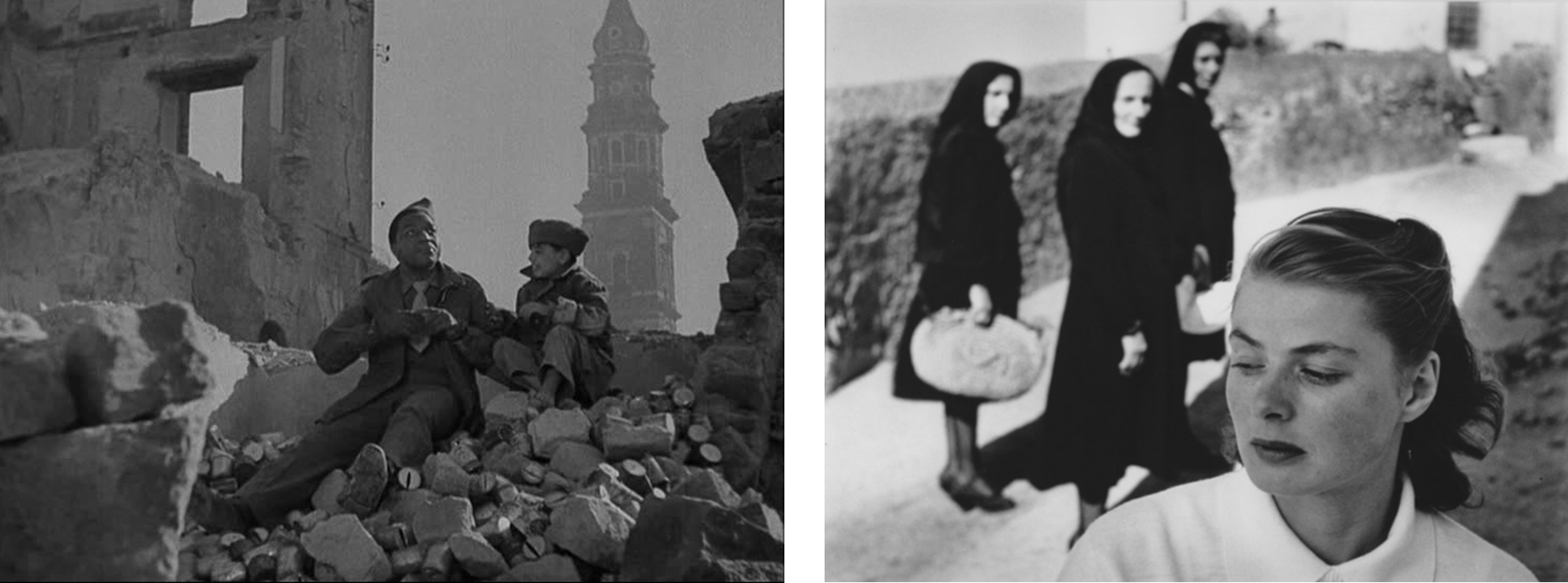
Figure 13 – Paisà frame,1946. Figure 14 – Stromboli frame, 1950, Roberto Rosselini.
Bazin describes this counterpoint to conventional, linear, escapist cinema imported from the major American studios as erratic and free movement of the camera: “Rossellini set out with his camera, film, and drafts of scripts that he modified at will according to his inspiration, material or human conditions, nature, landscapes” (BAZIN, 1991: 247). “What matters is the creative movement, the particular genesis of situations. The necessity of the narrative is more biological than dramatic; it springs forth and grows together with the verisimilitude and freedom of life” (BAZIN, 1991: 248). In this new cinema, the integration of deviation and slowness is explored within the central structure of the narrative. In Stromboli and Viaggio in Italia, the characters are erratic, driven by circumstance, ensnared in a leaden inaction that expresses the formal structure of the film itself. Italian neo-realist cinema abandons the idea of a predefined form and calls for a format that can be adapted to non-professional actors, to circumstance, and to improvisation.
In this sense, Gilles Deleuze (1925-1995) characterizes neorealism not in terms of its portrayal of a social condition but by the submission of the characters to a context. Regarding the film Senso by Visconti, set in the heavy historical atmosphere of Venice, the philosopher states: “the character has become a kind of spectator. They record more than they react” (DELEUZE, 2006: 13). This yielding to a particular situation, to a set of specific circumstances, once again reflects an indelible belonging to a context.

Figure 15 & 16 – Senso frames, Luchino Visconti,1954.
This adherence by cinema to fragments and collage, to freedom and errancy, and the depersonalization of characters as strong agents of action, represents the cinematic expression of the same weak form that is evident throughout the Italian cultural ecosystem following the fall of the Mussolini regime. The deviation and deconstruction of the culture of the dominators, the adoption of the perspective of the underdogs, and the narrative in its minor form, within the invisible social fabric, are the hallmarks of a new trend. Rejecting closed and moralizing narratives and a classical mise-en-scène, neorealism adopts the fragment, errancy, and inaction of characters trapped in limiting circumstances, thus constructing a new order.
This new cinema emerges as a counterpoint to the formal structure exported by American cinema. It demonstrates the failure of the decontextualized repetition of a canon. In parallel, drawing an analogy with the field of Architecture, the contexts of urban reconstruction marked by History, by the identity of the urban fabric, or by a specific social order, reveal, in their resistance, the limits of the possibility of repeating modernist dogmas. The deviation of cinematic artistic expression corresponds, by analogy, to the deviation produced by the inquiry into vernacular architecture during the decline of the fascist regime: cinema, in its neorealist expression, recognizes and announces the weak form.
3. Weak Thought
3.1 Everyday Life. Venezia Minore . Suspension before action.
“It was this other critical sense… that led Siza to carefully study the urban fabric of Venezia Minore – described by Egle Trincanato – to implement his plan for the Giudecca. (…)
In Campo di Marte, Siza finally understood why it was worthwhile studying the urban form and social life of this Venezia Minore, in which it is still possible today to build true bonds of neighbourliness.” (GRANDE; CREMASCOLI, 2016: 45 and 65)
It is within this cultural context that Egle Trincanato published the Venezia Minore study in 1948.
The decline of the strong thinking associated with fascist ideology and its proclamation of progress is accompanied, in the field of Architecture, by a debate on issues of History and contextualization. These become more important and partially undermine the modernist principles that advocated an architecture of unquestionable redemption and efficacy. Marginal narratives began to emerge on the ideological level, manifesting themselves in areas such as architecture or cinema. They explore a minor aesthetic, of fragments and deviations, of weak thinking, related to a knowledge of proximity, whether vernacular, rural, or urban, which is unique to each work. The Milan and Venice architecture schools, organizations like the Triennale di Architettura, and various publications contribute to the debate and produce a consistent theoretical body of work in an attempt to validate the trends presented by a critique of modernism.

Figure 17 & 18 – Venezia Minore, Egle Renata Trincanato, 1948 (Source: Archive Progetti. Università Iuav di Venezia).
Following publications such as Arquitectura Rurale Italiana, which establish new possibilities on the margins of the modern international canon, Venezia Minore is an inquiry into minor architecture within the urban context.
This detailed, historical, and typological study of the morphology of the common fabric is a work of attention and proximity, structured around the minor, anonymous buildings that form the urban network—the invisible map of the city. It distances itself from the narrative centred on protagonist buildings that are self-referential, typical of the discourse of modernity or rhetorical monumentalism.
“In no other city than Venice has the particular urban topography so strongly influenced the intimate characteristics of architecture, especially minor architecture, which is more connected to its environment, and has partly maintained its original medieval aspect and suffered little damage. This city, whether due to the impossibility of expansion or the fortunate absence of hypertrophic improvisations, has been saved – in the last hundred years – from the ordinary transformations and uncontrolled demolitions to which other cities have fallen victim” (TRINCANATO, 1948: 35).
Trincanato attributes the strength of the city, its resilience, to the minor fabric. Her theoretical and academic investigation seeks to reveal the morphology underpinning this structure, the common hidden matrix of architectural composition originating from the repeating fragment that articulates and gains meaning within the whole. It is an attempt to produce an alphabet, an abacus, of what is at the centre of each city’s identity but not immediately visible. The method used is akin to philosophy, as it seeks to understand the fundamental structures and attempts to reveal these categories by means of an intensified focus. Methodical, scientific investigation, while simultaneously grounded in the experience of daily life, manages to translate into an erudite record the architectural morphology that is close to the human scale.
In contrast to the unitary and rationalist principles promoted by the architecture of Mussolini’s regime in the previous decade, Trincanato counters with the fragility of the spontaneous, organic, and plastic fabric of minor buildings.
Despite its regional context, Trincanato aligns herself with the international context of the modern movement. This is visible in her participation in CIAM VII in Bergamo and the CIAM Summer School at IUAV in 1952; the 1953 edition was inaugurated by Le Corbusier (1887-1965) [9].
In her design practice, Trincanato does not shy away from integrating, both formally and ideologically, the commitments of the modern movement. Her proposals for the competition for the Hotel Danieli in Venice and the Ospedale del Mare in the Lido demonstrate this adherence and her knowledge of the central morphological codes of modernism.

Figure 19 – Albergo Danieli Competition, Venice, sketch by Egle Trincanato, 1946 (Source: Archive Progetti. Università Iuav di Venezia).

Figure 20 – Ospedale al Mare, Lido Competition, sketch by Egle Trincanato, 1946 (Source: Archive Progetti. Università Iuav di Venezia).
In a letter addressed to Il Mondo on the controversy over the Masieri Memorial [10],
designed by Frank Lloyd Wright (1867-1959 ) for Venice, which proposed replacing the historic Casa Rossa building, Trincanato takes a stand in favour of contemporary architecture, defending the grafting of modernist architectural language onto the “significant environment characterized by Venice”. According to this letter, in defence of this exception, Trincanato asserts that “a work of art should be judged on the level of art and not on that of taste,” and she defends “the architecture of stone, whose tactile, plastic, and dynamic values are the values of the artist’s poetry” (TRINCANATO, 2015: 81). She argues that the project will “elevate the historical context without creating contrasts that disturb the balance, allowing contemporary works of art to coexist with the historical fabric.” In this text she attacks the “false, vulgar, tedious and equivocal imitations of the past, replicas that stem from the retinal and surface image, as a way of betraying the city” (TRINCANATO, 2015: 131).
3.3 Temporality
INAIL. Minor history and Modernity
Between 1947 and 1961, in collaboration with Giuseppe Sámona, Trincanato developed a proposal for the INAIL headquarters in this consolidated and historical urban fabric of Venice. The consolidated fabric of the city of Venice, along with the history that underpins the entire theoretical context of the Venice School, is the place where architecture tests its resilience. In this project, two trends coincide: the concrete experience of the city, fixed in Venezia Minore, and contemporaneity, aligned with rationalism and modernist principles. The transposition of the strong discourse of modernity is here contaminated by the fragile, vernacular forms of the minor fabric. Weak thought is not an opposition but rather a mode of plastic transformation of the architectural currents of strong thought.

Figure 21 & 22 – INAIL headquarters in Venice (Photograph by Paolo Monti, Ferruzzi, Egle Trincanato, c.1960 (Source: Casabella, no. 244. 1960, pp. 5-6).
The project extended over a long period, and involved successive acquisitions of buildings. Accepting this condition of discontinuity and constant alteration, the INAIL is designed from this fragmentation. Initially (1947), restoration of the Ufficio Rendite is planned, but only the later buildings, set back from the street, are restored. In the second phase (1949), expansion of the Central Headquarters is proposed to formally integrate the two buildings.
With the acquisition of the Palazzo Adoldi (1951), the Central Headquarters is redesigned (1951-1961), opting for a façade with rationalist tendencies, rhythmically varied by the chromatic changes in the materials, thereby attributing formal unity to the building. Inside, the internal courtyard attains its final form (MARRAS; POGACNIK, 2006).

Figure 23 – Diagram of the evolution of the INAIL headquarters project in Venice. Drawn by the author.
The plan expresses this condition of an architectural artefact built in an organic movement, assembling the new acquisitions through joints that reveal the evolution of the process. The project strategies range from restoration to the replacement of buildings, accepting the specificity of each urban fragment. The marks of this collage are highlighted in a Cadavre Exquis, which is articulated around a central cloister, with heterogeneous façades.


Figure 24 – Plans of INAIL Headquarters, Venice, 1979 (Source: Archive Progetti. Università Iuav di Venezia).
In this organic composition, the central element is the façade facing Calle San Simeone, whose regularity contrasts with the variation in the interior compartmentalization. In contrast, the rear façade is designed to accommodate the irregularities of the project and the variation of spaces surrounding the central Cortile.

Figure 25 – West (Calle San Simeone) and East (Cortile) elevations of the INAIL Headquarters, Venice, 1979 (Source: Archive Progetti. Università Iuav di Venezia).
As demonstrated in the Venezia Minore study, where typologies are analysed based on the structure of the façades, the relationship of the INAIL building with the city is also established through its imposing façade. As in the example of Calle Colonne, where the “organic plan and a general compositional rhythm, skilfully derived from the chimney flues, almost like caesuras, determine a kind of rhythmic sequence,” [23], the façade of the INAIL building is also constructed in an organic, scenographic, regulated manner, modelled on the long Venetian typologies. It is simultaneously contemporary, atmospheric, and rationalist. The geometric and rigid design is adapted, in its horizontal partitioning, to the adjacent Palazzo Adoldi, which forms part of this ensemble. The choice of the façade as the element of rigorous composition and urban integration adapts the rationalist language and the modernist principle of repetition and prefabrication, incorporating the typical partitioning of Venetian typologies. At the top of the building, a continuous Altana is included.
As with minor Venetian typologies, the contrast between the continuous expression of the exterior façade and the fragmented interior of the Cortile, designed with elements of domestic character and scale, reinforces the hierarchy. It establishes the principal façade as the visible face of the building within the city. This distance between the street frontage and the interior planes is a decisive factor in the building’s design, creating completely distinct environments in terms of materiality, composition, and scale.

Figure 26 & 27 – INAIL Headquarters, Venice. Calle San Simeone façade and cortile façade. (Photographs by Paolo Monti, Ferruzzi, Egle Trincanato, c. 1960. Source: Casabella, no. 244, 1960, pp. 8 and 10).
Regarding the INAIL building, Trincanato writes: “On the other bank of the Grand Canal, the INAIL building, constructed between 1950-56, with prior approval by the Directorate of Fine Arts of the Ministry of Education, providentially avoided controversy, perhaps because the nervous, original, and vibrant façade—although far from any mystifying interpretations of past forms—did not directly face the Canal” (TRINCANATO, 2015: 145).
Highlighting the vibrant and dynamic façade as the project’s defining feature, Trincanato underscores the building’s connection to Venetian typology. This connection does not stem from a direct transposition of the Palazzo morphology but from the representation and prominence of the façade plane in shaping the city’s identity.

Figure 28 & 29 – INAIL Headquarters, Venice, 2015 (Photographs by Xavier de Jauréguiberry. Available at: www.flickr.com).
The choice of stone as the façade material, along with its division into fragments that derive meaning from the geometry of the whole, transforms the building’s abstract design into a sensory design of vibrancy. From the street-level perspective, the interpretation is characterized by discontinuity and fragmentation, while the view from the canal reveals a continuous interplay of shadow and light, rhythmically infused with colour.
The INAIL project rejects the notion of transcending rationalism and the principles of modernity, shaping itself through theoretical knowledge—not through replicating imagery but by engaging with the historical city, meticulously documenting its common typologies and marked fragmentation. The minor fabric dissolves into a prevailing continuum. The INAIL building rejects the ambiguous counterfeit of imagery and embraces the principles of the fabric in which it is situated: composition as fragment, alternating between restoration and reconstruction; the elevation of the street façade as the defining element of identity; the contrast between the exterior face and the courtyard; the adaptation of the façade to the adjacent historic building, culminating in an Altana; and the immateriality of the façade, expressed through the evanescent vibration that Venice, in its interplay with the canals, finds in the discontinuity of its reflections.
3.2 Dissolution. INAIL Headquarters. The elastic City and atmosphere
For Vittorio Gregotti (1927-2020) the INAIL Headquarters in Venice is the tangible expression of an atmosphere: “The way it is integrated into an urban ensemble is linked not so much to physical continuity but to a Venetian atmosphere, expressed through a chromatic variation composed more of coloured shadows than colours… As if the base emerged from the water and the entire façade vibrated with an unstable, reflective light.” (GREGOTTI, 1960: 5).
The description of the building seeks to position it between historical heritage and contemporaneity, distancing it, however, from the poetics of transposing the traditional image of Venetian palaces. Instead, it is designed through the interplay of detail in the Venetian manner, and modernity. Gregotti’s vision transcends the usual grammatical codes of modern architectural critique, describing the building as an atmosphere, aligning it with a broader perspective of the city.

Figure 30 – INAIL Headquarters, Venice, sketch by Egle Trincanato. (Source: Archive Progetti. Università Iuav di Venezia).
According to Francesco Dal Co (1935), the INAIL Headquarters embodies Venetian architecture in its most resilient identity, as an expression of a construction method based on the assemblage of parts into a compositional and decorative whole. For this historian, Venice was never Roman but instead persisted in its elasticity and malleability, reflecting a Byzantine structure.
Unlike Rome, Dal Co notes, “Venice has no ruins” (Interview with Francesco Dal Co, 2024). For this reason, Venice is not inferior; Venice is elastic, open,” characterized by the way it was built—both the city’s ground and its buildings—using constructive details that allow the entire structure to remain mobile. This elasticity enables it to adapt to the movements of a territory that arose as an “impossibility, as landfill reclaimed from the water.” Dal Co describes Venice as a flexible organism, a “continuous, plastic, resilient body that adapts, regenerating itself continuously, constructed through the aggregation of fragments” into a complex whole.
The flexibility of the details that form the structural base of Venetian buildings, according to Dal Co, is the key to understanding the city’s architecture. This structural detail, evident in the restoration of Palazzo Adoldi, takes on an external and visible expression in the INAIL Headquarters building. This flexible connection, both structural and architectural, is updated and amplified in the façade facing the Calle San Simeone. The systemic façade transposes its internal structure of assembly and free fragmentation into an exoskeleton. This allows for settlements and adjustments on terrain built on a liquid surface. This is the strength of the fragment—the malleability of the system, endlessly broken and, therefore, infinitely adaptable.

Figure 31 – Diagram by Francesco Dal Co made during the interview, Porto, 2024 (Source: Photograph by the author). Figure 32 – Detail of the INAIL Headquarters in Venice, Palazzo Adoldi, 1951–60. (Source: Archive Progetti. Università Iuav di Venezia).
In this process of progressive segmentation, through secondary substructures of concrete, brick, marble, and metal, the INAIL project translates the use of light and decoration from the Byzantine world. The façade of the INAIL building, designed as the antithesis of a continuous skin, as a successive decomposition into light and shadow. It is a composite made of fragments, an acceptance that the elements, together in a complex and articulated system, produce the resilient force that Venice embodies. From the fragile components, a tectonic assembly is created that returns the building to the city, dissolving it within this relationship.

Figure 33 & 34 – INAIL Headquarters in Venice. Façade of Calle San Simeone (Photograph by Egle Trincanato and Giuseppe Samonà, 1956. Source: Archive Progetti. Università Iuav di Venezia).
Like the city of Venice, whose strength is expressed through its anonymous and fragile fabric, this building derives its force and resilience from the assemblage of its delicate components. It is in the interplay between past and present, city and building, formal principles and their variations, that the fragile narrative finds the depth and complexity of its architecture. The historical weight and the minor urban fabric of Venice provoke a redefinition of archetypal forms, characteristic of the major 20th-century movements, resulting in their critical, contextualized, and revised appropriation.
Conclusion
The theoretical and practical work of Egle Trincanato represents a nuanced variant of the strong ideology championed by the modernist movement. Her engagement with the city, especially in its minor forms, is epitomized in her seminal book, Venezia Minore, which serves as an instance of resistance and transformation against the generic principles propagated by modernism.
The urban strength of the Venetian context, rooted in the fragmented, real, and cohesive fabric that forms the city’s identity, constitutes the shared foundation for interventions. This organic fabric, in constant flux, absorbs difference in a continuous dialectic between the resilience of the past and the transformation of the present. In this sense, the contamination of the context redefines the formal and typological canon of modernist discourse, creating fractures within a unified historiographic narrative. The city becomes a tangible, lived reality—a shaper and transformer of architectural thought. The city is the greater instance, while architecture serves as the fragment, the smaller expression of the whole.
Trincanato, an advocate of modernist principles, does not distance herself from the lessons rooted in daily life and careful attention to the nearby urban fabric. The survey conducted in Venezia Minore focuses on the anonymity of the minor buildings rather than the prominent landmarks of Venice. Her method is rooted in observation, drawing, and a typological lexicon. Venezia Minore is not merely a theoretical academic exercise aimed at stabilizing a typological canon, but rather an operational and transformative legacy for architectural practice. This design practice is evident in the INAIL Headquarters, reflecting a deep engagement with the knowledge of the city. Egle Trincanato’s work confirms her commitment to the modernist matrix that dominated the 20th century while simultaneously engaging with the city that hosts and transforms it. By neither seeking to surpass nor to ambiguously replicate the past, her approach can be understood as a unique mode of intervention. The urban fabric, in its elasticity, becomes an uncommon inflection point for modernist projects—a fragile context capable of transforming strong ideologies.
In affirming the importance of place, Trincanato lays the foundation for a theoretical framework that views architecture as a philosophical activity. She seeks out the alphabet, the invisible abacus that shapes the urban fabric. This moment of suspension before the act of designing serves as a form of mediation between discourses—between philology and neologisms, between building and city. In response to the polarization of the debate on urban intervention, heritage, and memory, Trincanato proposes the city as an instance of mediation.
She counters the failure of rigid ideological narratives with the fragile, personal narrative. In contrast to modernism’s radiant, repeatable, and abstract utopia, she offers critical action and the contextual declension of place and the minor form, balancing rationalist tendencies with the resistance of the vernacular, uniting transformative action with continuity.
In this framework, it is the “minor” fabric of Venice that constitutes her strong discourse. The hidden identity that endures despite change, the cohesive totality, and the invisible fragility of cities form a resilient, elastic, and continuous organism. This resilience of the weak fragment introduces, within the discipline of architecture, a constant critical updating of the premises and codes of the modernist movement, dissolving it in the context, expanding its possibilities, fragmenting it, declining its discourse, and continuing, in this fragile heresy, the modernist legacy.
Bibliography
AGOSTINI, Tiziana; CALABI, Donatella; VISCONTI, Federica; NIGLIO, Olimpia; BALISTERI, Emiliano – L’autorevolezza lieve Egle Trincanato a cent’anni dalla nascita. Giornale Iuav 83. Venice, Università Iuav di Venezia, 2010.
BALISTERI, Emiliano (coord) – Egle Renata Trincanato: Ordini restauro Venezia. Veneza-Mestre: Edizioni Stamperia Cetid, 2000.
BALISTERI, Emiliano – Egle Trincanato (1910-1998). Profilo biografico. 2018. Available at: www.academia.edu/36112892/Egle_Trincanato_1910_1998_Profilo_biografico [Consulted 26/11/2024].
BALISTERI, Emiliano – Egle Renata Trincanato. Estratto dal testo elaborato dall’autore per la mostra La Venezia di Egle Trincanato, Librerie Feltrinelli, Veneto, 2011. Available at: www.academia.edu/36051787/La_Venezia_di_Egle_Renata_Trincanato?source=swp_share [Consulted 26/11/2024].
BALISTERI, Emiliano – Egle Renata Trincanato, Regesto delle opere. 2007. Available at: www.academia.edu/2760633/Egle_Renata_Trincanato_Regesto_delle_opere [Consulted 26/11/2024].
BALISTERI, Emiliano – I progetti di Egle Trincanato per edifici da erigersi nel Centro Storico di Venezia. Originally published in esempidiarchitettura, 2010. Available at: www.academia.edu/2761551/I_progetti_di_Egle_Trincanato_per_edifici_da_erigersi_nel_Centro_Storico_di_Venezia [Consulted 26/11/2024].
BALISTERI, Emiliano (coord) – Le Corbusier, Neutra, Scarpa e Wright. Architetti modernisti a Venezia. Documenti, progetti, scritti e testimonianze dall’archivio di Egle Trincanato. Rome: Aracne Editrici, 2015.
BAZIN, Andre – Qu’est-ce le cinema?. Paris: Les êditions du Cerf, 1985.
BAZIN, André – O Cinema: ensaios. São Paulo: Editora Brasiliense, 1991.
BENJAMIN, Walter – O anjo da História – Teses sobre o conceito de História. Lisbon: Assírio e Alvim, 2010.
CAMPOSTRINI, Tullio (coord.) – Costruire a Venezia. Trent’anni di edilizia residenziale pubblica. Venice: Il Cardo, 1993.
CARULLO, Rossana – IUAV. Didattica dell’architettura dal 1926 al 1963. Bari: Politecnico di Bari, Facoltà di Architettura / POLIBAPRESS, 2009.
DELEUZE, Gilles – A Imagem-Tempo Cinema 2. Lisbon: Assírio e Alvim, 2006.
FIORINO, Donatella – Le “gran dame” dell’architettura nell’Italia del Novecento e il progetto sulle preesistenze. ArcHistoR anno VI, n.º 11, 2019, p. 126-167.
FRAMPTON, Kenneth – História Crítica da Arquitectura Moderna. São Paulo: Martins Fontes, 2003.
GRANDE, Nuno; CREMASCOLI, Roberto (eds) – Álvaro e Aldo e aprendendo com a Venezia Minore, Vizinhança. Álvaro Siza Vieira: Vizinhança: Onde Álvaro encontra Aldo – Representação Portuguesa na Bienal de Veneza 2016. Berlin: Hatje Cantz Verlag, 2017, p. 45, 65.
GREGOTTI, Vittorio – La nuova sede dell’INAIL a Venezia di Giuseppe Samonà. Collaborator: Egle Trincanato. Casabella 244. Milan, 1960, pp. 4-13.
IIHYUN, Kim – Alcuni episodi della biografia intellettuale di Samonà. Dai rapporti com la scuola romana alla scuola estiva dei CIAM. – Giuseppe Samonà e la Scuola di Architettura a Venezia. Venice: il Poligrafo, IUAV – AP archivio progetti, 2006, p. 61.
MARINETTI, Filippo Tomaso – Manifesto futurista. Le Figaro, 1909. Available at: https://commons.wikimedia.org/w/index.php?search=Manifestofuturismo&title=Special:MediaSearch&go=Go&type=image [Consulted 26/11/2024].
MARRAS, Giovanni; POGACNIK, Marco – Giuseppe Samonà e la Scuola di Architettura a Venezia. Venice: il Poligrafo, IUAV – AP archivio progetti, 2006.
MOHOLY-NAGY, Sybil – Conferência em Pittsburg. Tradução de Bruno Zevi segundo Tafuri, Manfredo. In TAFURI, Manfredo – Teorias e História da Arquitectura. Lisbon: Editorial Presença, 1988, p. 32.
MOLINARI, Luca; SCRIVANO, Paolo (eds.) – Arquitectura italiana de la posguerra. 2G n.º15. Barcelona, 2000.
NESBITT, Kate (coord.) – Uma nova agenda para a arquitetura. A escola de Veneza. São Paulo: Cosac Naify, 2006.
PAGANO, Giuseppe; DANIEL, Guarniero – Architettura Rurale Italiana. Milan: Ulrico Hoepli Editore, Quaderni della Triennale, 1936.
PILIA, Elisa; PINTUS, Valentina; PIRISINO, Maria Serena Pirisino; PORCU, Martina; VARGIUN, Monica – Tutela e progetto sulle preesistenze. Letture e confronti tra esperienze al femminile nell’Italia del dopoguerra. ArcHistoR anno VII, n.º 13, 2020, pp. 252-305.
PINTUS, Valentina – La città viva di Egle Renata Trincanato. Note e riflessioni dagli archivi. Venice: IUAV/Cagliari, UNICApress, 2023.
RODRIGUES, José Manuel – Teoria e crítica de arquitectura. Século XX. Lisbon: Caleidoscópio, 2010.
ROSSELINI, Anna – La sede dell´INAIL a Venezia di Giuseppe Samonà, 1947-1961: oltre lo strutturalismo. In MARRAS, Giovanni; POGACNIK, Marco – Giuseppe Samonà e la Scuola di Architettura a Venezia. Venice: il Poligrafo, IUAV – AP archivio progetti, 2006, p. 37-59.
SALEMA, Isabel – E de uma exposição Siza fez um edifício para 19 famílias. Público. 17/11/2017.
SALEMA, Isabel – Finalmente Siza vai terminar o edifício da Giudecca em Veneza. Público. 26/11/2016.
SCIMEMI, Maddalena – Riscrivere l’architettura: Venezia minore e il volto delle città. In SCIMEMI, Maddalena; TONICELLO, Anna – Egle Renata Trincanato 1910-1998. Venice: Marsilio Iuav Fondazione Querini Stampalia, 2008, pp. 10-23.
SCIMEMI, Maddalena – Venezia internazionale. La CIAM Summer School 1952–1957. IUAV: 83. Venice, p. 5.
SCIMENI, Maddalena; TONICELLO, Anna (coords) – Egle Renata Trincanato 1910-1998. Venice: IUAV/Marsilio, 2008.
SOLÀ MORALES, Ignasi – Arquitectura Débil em Diferencias: Topografía de la Arquitectura Contemporánea. Barcelona: Gustavo Gilli, 2003.
TAFURI, Manfredo; DAL CO, Francesco – History of the world Architecture, Modern Architecture 2. Milan: Electa/Rizzoli, 1986.
TAFURI, Manfredo; DAL CO, Francesco – Storia dell’architettura, Architettura Contemporanea. Milan: Electa/Rizzoli, 1976.
TAFURI, Manfredo – Storia dell ‘architettura italiana – 1944-1985. Turin: Piccola Biblioteca Einaudi, 2002 (1st ed. 1985).
TENTORI, Francesco – Egle Renata Trincanato e la Scuola superiore di architettura di Venezia. Venice: Fondazione Querini Stampalia, 2003.
TRINCANATO, Egle Renata – Venise au fil du temps. Boulogne: Editions Joel Cuenot, 1971.
TRINCANATO, Egle Renata – Venezia Minore. Venice: Filippi Editore, 1948.
VATTIMO, Gianni – Pensiero Debole. Milan: Feltrinelli Editore, 1983.
VATTIMO, Gianni – O fim da Modernidade. Niilismo e Hermenêutica na cultura Pós-moderna. Lisbon: Editorial Presença, 1987.
Other Sources
Francesco Dal Co, Interview conducted on 4 July 2024 in Porto.
Notes
1. Egle Renata Trincanato was born in 1910. She became the first female architect to graduate, in 1938, from the Regio Istituto Superiore di Architettura di Venezia, later known as the Istituto Universitario di Architettura di Venezia and now the Università Iuav di Venezia. In 1941, she was appointed as an Assistant in the chair of Disegno Architettonico e Rilievo dei Monumenti (Architectural Drawing and Monument Surveying). She won third place in the competition for the Ospedale al Mare del Lido (1947) and won first prize in the competition for housing construction promoted by the Municipality of Venice. In 1947, she won the competition for Capo della Divisione tecnico-artistica (Head of the Technical-Artistic Division) after appealing against the exclusion of female candidates. In 1948, she published Venezia Minore. She was appointed Director of the Doge’s Palace (Palazzo Ducale) in 1954, Deputy Director of IUAV in 1974, and President of the Fundacione Querini Stampalia in 1990. Trincanato’s academic, institutional, and professional career, along with her contributions to architectural criticism, intersected with key figures of modernism, such as Giuseppe Samonà (1898–1983), with whom she collaborated extensively, as well as Le Corbusier, Richard J. Neutra, and Frank Lloyd Wright. She received the Premio Nazionale Olivetti per la Critica d’arte, awarded by a jury that included Giulio Carlo Argan, Adriano Olivetti, and Bruno Zevi. At IUAV, she worked alongside Giancarlo De Carlo and Aldo Rossi. She met Richard Neutra and Frank Lloyd Wright and participated in the CIAM VII (Congrès Internationaux d’Architecture Moderne) held in Bergamo in 1954. Throughout her academic and architectural career, Egle Renata Trincanato worked as an assistant and collaborator with architect Giuseppe Samonà, contributing to competitions, territorial and architectural projects, including the Progetto di Quartiere INA-Casa a San Giuliano and the Progetto di Palazzo per uffici e abitazioni INAIL..
2. Egle Renata Trincanato Exhibition. Venezia: forma e rinnovamento at the Querini Stampalia Foundation in 2008.
3. Vattimo, Gianni. Il Pensiero Debole. Milan, Feltrinelli Editore, 1983.
4. Valori Plastici. A magazine published in Italy between 1918 and 1922 in opposition to the values of the avant-garde in the visual arts.
5. Gruppo 7 was formed by Sebastiano Larco, Guido Frente, Carlo Rava, Adalberto Libera, Luigi igini, Gino Pollini, and Giuseppe Terragni
6. “Our past and our present are not incompatible. We do not wish to ignore our traditional heritage.” “(Casa del Fascio) was originally designed around an open courtyard, following the model of the traditional palazzo.” (FRAMPTON, 2003: 147 and 249).
7. EUR 42 – The 1942 Universal Exposition in Rome, planned in the 1930s and cancelled following the outbreak of the Second World War, corresponds to a monumental urban complex originally conceived to celebrate the twentieth anniversary of the Fascist March on Rome. Its construction was resumed from the 1950s to the 1970s.
8. The films mentioned are Paisà (1946) from the War Trilogy, Stromboli (1950) and Viaggio in Italia (1954) by Roberto Rosselini; Senso (1954) by Luchino Visconti; and Ladri di Biciclette (1948) by Vittorio De Sica.
9. The VII Congress of the CIAM (Congrès Internationaux d’Architecture Moderne), held in Bergamo in 1949, was responsible for the CIAM urban planning grid, which adhered to the modernist dogmas and the principles of the ASCORAL group (Association des Constructeurs pour la rénovation architecturale). This Congress also decided on the creation of the CIAM Summer School. The second edition of this Summer School took place at the IUAV (Istituto Universitario di Architettura di Venezia) in September 1952, and the following edition was inaugurated by Le Corbusier.
10. Frank Lloyd Wright, unbuilt proposal for the Masieri Memorial in Venice in 1954.