

João Miranda
joaomhmiranda@outlook.com
Architect and PhD candidate at the Department of Architecture at the Autonomous University of Lisbon (DA/UAL), Portugal. CEACT/UAL – Centre for Architecture, City and Territory Studies of the Autonomous University of Lisbon, Portugal.
To cite this article:MIRANDA, João – Begin Again. Fail Better. Estudo Prévio 28. Lisbon: CEACT/UAL-Centre for Architecture, City and Territory Studies of the Autonomous University of Lisbon, June 2026, p. 173-182. ISSN: 2182-4339 [Available at: www.estudoprevio.net]. DOI: https://doi.org/10.26619/2182-4339/28.02
Received on January 11, 2026 and accepted for publication on March 11, 2026.
Creative Commons, licence CC BY-4.0: https://creativecommons.org/licenses/by/4.0/
[1]
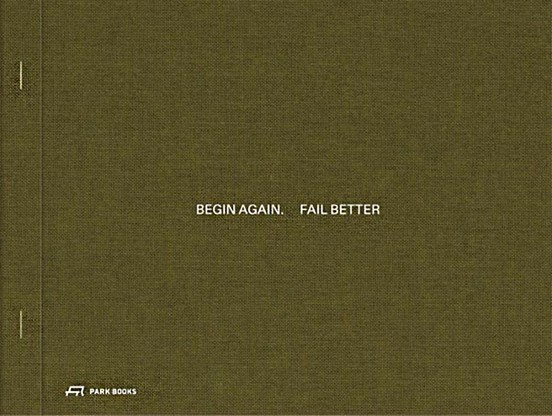
Begin Again. Fail Better was published on the occasion of — and following — the exhibition Begin Again. Fail Better – Preliminary Drawings in Architecture (and Art), held at the Kunstmuseum Olten, in Olten, Switzerland, between 1 June 2024 and 25 August 2024. However, the published volume deliberately omits the art component that formed part of the exhibition’s original premise. Departing from the framework established by an exhibition presented within an art museum, the publication focuses predominantly on architecture, undertaking a critical redefinition of the disciplinary field and of the role of drawing as a conceptual and experimental design tool, a working process, and a communicative instrument [2].
The concept, idea and research underpinning Begin Again. Fail Better, a curatorial and editorial project, originate with Manuel Montenegro. The project, whose title is inspired by a quotation from a work by Samuel Beckett published in the 1980s, was gradually developed by Montenegro around one of the architect’s central activities within the design process: drawing, more specifically hand drawing. This research is informed both by his experience of working with archives, at national and international levels, and by his extensive knowledge of the Drawing Matter Collection (DMC), based in the United Kingdom — particularly the body of material relating to the Portuguese architect Álvaro Siza — and of the organisation of the same name. These factors converged in the conception of a project that takes as its point of departure the drawings held within the collection, a significant proportion of which consist of hand drawings.
Begin Again. Fail Better does not present itself as a portrait, nor as a state of the art of drawing practice in architecture (or in the visual arts). Nevertheless, it seeks to affirm drawing as a central instrument of architectural thought. The drawings — composed of lines, forms, and shapes executed through a variety of techniques — embody a continuous process of investigation, giving form to an ever-evolving exchange between experience and knowledge [3]. The project encourages a process of reflection, introspection, and self-evaluation, not only on the part of its principal authors, but also on the part of all contributors to the publication. In this respect, it is no coincidence that the book begins with a drawing, and that the first drawing presented in the publication — which also serves as the visual reference for the exhibition — is a hand-drawn self-portrait by Álvaro Siza, dated 1980 [4].
It is strange to begin with failure, even if its aftermath can be long,
because although failure occurs in an instant, it happens within a continuum. [5].
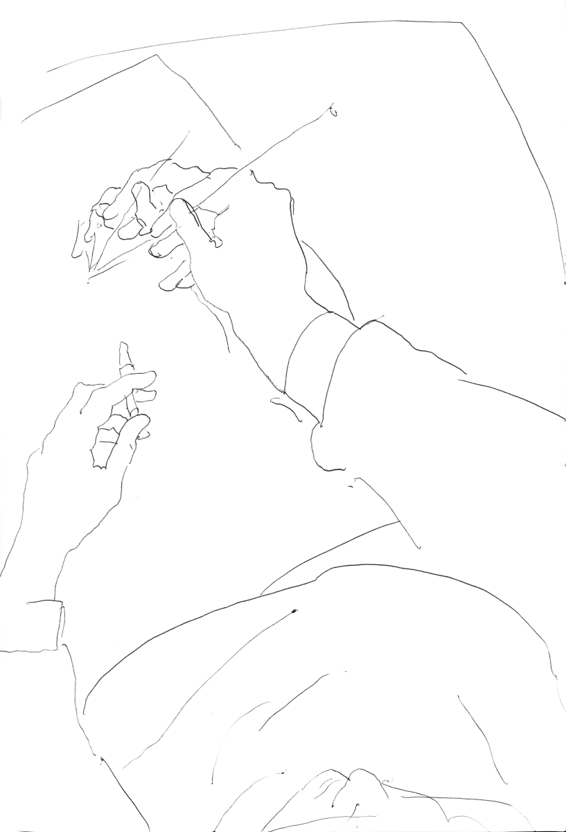
Figure 1 – Drawing [Self-Portrait] by Álvaro Siza, 1980 (Source: Drawing Matter / © Álvaro Siza)
Taking the Drawing Matter Collection as its point of departure, the representation of principles through drawing is developed through the inclusion of institutions based in Switzerland [6]. To these are added more than fifty international architectural practices, contributing to the construction of a landscape of Swiss architectural practice [7].
Thus, a dual relationship is established between the organisations/institutions that host collections and the authors of drawings who, situated outside these same institutional structures, remain embedded within architectural practices. From its very genesis, a continuous dialogue is configured between contemporary material designated as historical and documentation arising from the practice of active architectural practices. In this way, documents of an archival — or not yet archival — nature are brought into relation with the design process itself, whether originating from institutions or from the authors themselves, situated across different geographies and contexts.
In a relationship of spatial and conceptual convergence, drawings by architects from Swiss architectural practices were brought together through an invitation issued by the project’s authors, who sought contributions of “drawings that are at the very beginning of an architectural process” [8]. First presented within the exhibition, these works were documented by Kaspar Ruoff (Kunstmuseum Olten), whose photographs constitute the publication’s primary visual record. Together, the drawings and their documentation form the foundation of the published book. Due to the large number of materials displayed in the exhibition — a selection of approximately two hundred works by architects, drawn from various collections and spanning a temporal range from the sixteenth to the twentieth century — it was not possible to include all the content in the publication. It was therefore decided, initially, to ensure the representation of all the architectural practices participating in the exhibition, through a careful selection of materials from the institutions/organisations involved [9].
Together with Montenegro, Helen Thomas and Marco Bakker form the triad of authors who formalised the editorial project in close collaboration with figures from the Kunstmuseum Olten (Dorothee Messmer and Katja Herlach). This is reflected in the very structure of the publication, which follows a tripartite logic. The first section is composed of the ‘Introduction’ and the only interview in the volume — an interview — sharing the same title as the book — conducted by Thomas and Bakker with Montenegro. Framed as a dialogue, rather than as a conventional essay, it reveals the process, intentions, and conceptual foundations of Begin Again. Fail Better.
The ‘Introduction’ situates the editorial production in relation to the literary work and develops the theme of drawing: not only as a manifestation of spatial thinking but also as a structuring device for ideas; and as constellations of text that relate the drawing process (and design process) to the publication’s guiding theme, as well as to various perspectives (and contexts) on drawings.
The second section includes the ‘Catalogue of Drawings’ and ‘Interludes’. The eight written essays (‘Interludes’) are authored by different contributors — Niall Hobhouse, Charles Pictet, Adam Caruso, Ludovica Molo, Irina Davidovici, Stéphanie Bender and Philippe Béboux, Matt Page, and Pier Vittorio Aureli — and are incorporated into the publication as moments of reflection between drawings referred to in the project as ‘preliminary’. These contributions address various themes closely related to their respective authors and offer a dense and stratified reflection on art, architecture, and drawing. The third and final section brings together four written contributions: three essays — by Messmer, Bakker, and Thomas — and a fourth contribution, consisting of a compendium of five texts (1978; 1979; 1980; 1983 and 2024) by Siza, selected and translated by Montenegro.
The book, measuring 225×300mm, in horizontal (landscape) orientation, bound in a soft linen cover with staples and printed on high-quality, high-weight paper, evokes the tactile and visual sensibility of an architect’s sketchbook in an enlarged format. Across its two hundred and eighteen pages, drawings are displayed on one hundred and seventy-seven of them, with some pages containing more than one drawing, forming sets of images. Its horizontal orientation reinforces this association, suggesting a mode of reading that is simultaneously physical and reflective.
Although the table of contents presents the sections with page references, the pages themselves remain deliberately unnumbered — a decision that accentuates the sense of informality and process characteristic of a sketchbook as a working object or notebook of an architect. This deliberate omission encourages a non-linear reading experience, inviting the reader to browse, revisit, and discover, rather than follow a fixed and predetermined sequence. The absence of pagination is conceptually aligned with the publication’s thematic focus: the act of observing and studying preliminary architectural drawings. It promotes a mode of reading that is attentive and unhurried, analogous to the experience of consulting archival materials in institutions or other collections, such as Drawing Matter.
The editorial decision to exclude page numbering may also be understood as an attempt to replicate the phenomenological encounter with original drawings, where sequence and hierarchy dissolve in favour of visual and material discovery. Likewise, the book’s graphic design suggests an affiliation with the tradition of architectural albums and sketchbooks — such as those of Siza — in which the materiality of the publication contributes decisively to the interpretative experience. The curatorial strategy transforms the book into an interpretative medium in its own right: an object that challenges the reader to oscillate between observing and examining, between critical analysis and questioning the process, between the visual immediacy of the drawing and the discursive structure provided by the reflections that accompany it.
In this way, the book functions simultaneously as an object of study and a curatorial artefact — something to be examined, contemplated, and visually experienced on multiple occasions. Its physical and visual qualities underscore its dual identity: a compilation of written and visual contributions, and a sensory object that mediates between the intellectual and aesthetic dimensions of architectural representation.
The format allows the drawings to occupy a substantial area on each page, enabling the reader to discern the subtleties of the line, the chromatic variations — and even the texture of the materials — as well as the compositional balance. This generosity of scale not only facilitates an appreciation of the technical and artistic qualities of each drawing, but also reinforces the editors’ curatorial intention: to place drawing in the foreground as both an instrument of thought and an artefact of architectural practice. For this reason, the publication cannot be adequately described merely as a book of systematically catalogued drawings or as the exhibition catalogue; rather, it should be understood as a reflective compendium, in which essays, contributions (‘Interludes’), and the drawings themselves are brought into dialogue — now published as a visual collection and a conceptual exploration of the role of drawing.
The publication, in addition to encouraging a slow and attentive mode of reading, places drawing at the centre of architectural reflection. Hand drawing, within this project, is presented as an instrument that continues to occupy a central position in architectural practice, being understood as an act that functions as a reservoir of ideas, a source of inspiration, or a playful means of discovering reference images, operating as a distiller of thought and opening a path towards self-exploration.
As mentioned previously, it is hand drawing that inaugurates the publication and, symmetrically, it is likewise hand drawing that concludes it, through a drawing by Charles Percier for an ideal museum project [10]. A cycle is thus closed, beginning with an origin anchored in a drawn reproduction by the architect-author himself — that is, a self-representation [a drawing taken from a sketchbook], in which his universe and the inaugural gesture, or principle, of a design process act (or not) can be observed — and culminating in a representation of an unbuilt project — an epilogue not yet realised, a space-place first conceived and rehearsed through drawing, evocative, nonetheless, of a possible architecture.
Between pages fourteen (the beginning of the ‘Catalogue of Drawings’ section, sporadically interrupted by the ‘Interludes’) and one hundred and ninety-seven, it becomes evident that the presentation of the works follows not only the diptych logic of the curatorial project of the original exhibition in Olten, but also the alphabetical order of the invited practices (and of some materials from the collections) [11]. This structure allows the reader to examine, side by side, ideas and preliminary traces expressed through different supports, media, and techniques. The arrangement of one drawing per page makes it possible to view two drawings simultaneously across a spread of the publication, rendering perceptible the nuances, variations, and principles that were either maintained or transformed throughout the process.
Begin Again. Fail Better invites reflection on the ways in which a curatorial and editorial undertaking can engage drawing simultaneously as both raw material and a means of representing the architectural process. Conceptually, through the act of drawing — predominantly by hand, although not exclusively, also incorporating digitally produced drawings — the project confronts and articulates drawing as an instrument of exhibition-making and publication in architecture [12].
Ultimately, one question that emerges is whether this publication represents a tentative exploration or a deliberate intervention in contemporary architectural discourse. Does it merely point towards an ongoing debate, or does it seek to redefine the terms of that debate through a renewed engagement with the act — and the process — of drawing? If the latter is the case, its position resonates with the opening words that introduced the exhibition, drawn from Beckett’s Worstward Ho (1983):
Ever tried. Ever failed. No matter. Try again. Fail again. Fail better.
This quotation encapsulates the productive potential of the begin–fail dialectic — beginning and failure — understood as a condition of repetition and continuity, and therefore as a critical and generative mode of practice. In the context of architectural drawing, the invocation of Beckett’s words reframes the act of making, not as the pursuit of something definitive, but as a continuous process of iteration, reflection, and (re)interpretation. This understanding aligns closely with the rhythm of the architectural process and of creative practice, which privilege experimentation, indeterminacy, and the provisional nature of disciplinary inquiry.
In an increasingly unpredictable present, contemporary architectural production is characterised by its capacity to navigate uncertainty, continually mutating, rethinking, and redrawing itself, while embracing the contingent and the ideals as spaces of potential beginnings — or failures. In this sense, Beckett’s words constitute a conceptual framework through which the publication’s critical position may be understood: the iterative, the unfinished, the speculative, the incessant, the determinate, and the continuous are valued as central elements of both architectural thought and practice.
In conclusion, this publication can be read simultaneously as a reflection and as a contribution to contemporary discourse on principles and on attempts, authorship, and process(es) in Architecture. It challenges conventional hierarchies between notions of success and failure, between the work and the (preliminary) drawing, instead asserting the enduring relevance of drawing as an instrument of thought — a space in which meaning is continuously deferred and (re)imagined.
[13]
Notes
[1] Begin Again. Fail Better (book cover), 2024. Source: Kunstmuseum Olten. The book titled Begin Again. Fail Better – Preliminary Drawings in Architecture was designed by Studio Matthias Clottu, a Swiss design and art direction practice based in London.
[2] The book was launched on 25 August 2024, at the finissage of the exhibition held at the Kunstmuseum Olten. Subsequently, the exhibition travelled — not to an art museum, but to a venue dedicated to architecture — namely the Archizoom at the École polytechnique fédérale de Lausanne (EPFL), in Lausanne, Switzerland, where it was presented between 5 November and 2 December 2024. Significantly, the title was (also) revised for its exhibition presentation at EPFL, becoming Begin Again. Fail Better – Preliminary Drawings in Architecture, thereby omitting the reference to art present in the original exhibition title.
[3] See, on this subject, the words by Manuel Montenegro: “All drawn lines are embedded with countless histories, experiences, and shared knowledge acquired from visits that have been made, books read, and problems resolved.” In Helen Thomas and Marco Bakker interview Manuel Montenegro, “Begin Again. Fail Better” (THOMAS; MESSMER; HERLACH; MONTENEGRO, , 2024: 10).
[4] The original drawing is located on page 22 of Sketchbook 51 (1980) by the architect Álvaro Siza. The sketchbook, comprising seventy-two pages and measuring 300×210mm, was acquired by Niall Hobhouse and, to date, belongs to the Drawing Matter Collection (DMC 2538). Source: DMC — Drawing Matter Collection.
[5] In Helen Thomas, “Sense, Sensibility, and Terms of Failure” (THOMAS; MESSMER; HERLACH; MONTENEGRO, 2024: 203).
[6] International institutions based in Switzerland, such as the Archives de la construction moderne — École polytechnique fédérale de Lausanne (Acm-EPFL), the ETH Zürich, Departement Architektur, Institut für Geschichte und Theorie der Architektur Zürich gta (Archiv) (gta Archiv), Balerna, Archivio del Moderno (AdM), Fondazione Archivi Architetti Ticinesi (FAAT), and Studio Vacchini (Studio Vacchini).
[7] The architectural practices included in the project, organised in alphabetical order, are: 2b architectes, 8000.agency, BABL, Barão Hutter, BCMA, Lillit Bollinger, Bosshard Vaquer, Buchner Bründler, Buol & Zünd, BUREAU, Buzzi Architetti, Caruso St. John, Christ & Gantenbein, Conen Sigl, Dreier Frenzel, Jean-Pierre Dürig, E2A, EMI Architekt:innen, Frei + Saarinen, GayMenzel, Gigon Guyer, Gmür Architekten, Graber Pulver, HHF, Manuel Herz, Jaccaud + Associés, Käferstein & Meister, Karamuk Kuo, Jan Kinsbergen, Knapkiewicz & Fickert, Büro Krucker, Lütjens Padmanabhan, LVPH, Corinna Menn, Miller Maranta, Pictet Broillet, Pool Architekten, Rapin Saiz, Lando Rossmaier, Enrico Sassi, Sauter von Moos, Schneider Türtscher, Sergison Bates, studioSER, studio we, studio WOW, Atelier Summermatter Ritz, Patrick Thurston, Truwant + Rodet +, WALDRAP, and Weyell Zipse.
[8] See, on this subject, Helen Thomas, “Sense, Sensibility, and Terms of Failure” (THOMAS; MESSMER; HERLACH; MONTENEGRO, 2024: 202–207). See, also, Marco Bakker, “The Element of Play in Drawing” (THOMAS; MESSMER; HERLACH; MONTENEGRO, 2024: 208–209).
[9] It should be noted that the proportion of material from Drawing Matter (DMC — Drawing Matter Collection) and from other sources differs between the exhibition and the publication, as a result of the editorial decisions adopted and the need to ensure a comprehensive representation of the architectural practices in the publication Begin Again. Fail Better – Preliminary Drawings in Architecture. Accordingly, material originating from institutions/organisations was reduced in the publication in comparison with the exhibition, prioritising, in the first instance, the representation of the invited practices, while nonetheless maintaining the diptych logic of the exhibition.
[10] See, on this subject, the Preparatory Drawing by Charles Percier — Projet d’un Muséum Idéal, 457×584mm, 1796. Item held in the Drawing Matter Collection (DMC 3291 r). Source: DMC — Drawing Matter Collection.
[11] In the exhibition Begin Again. Fail Better – Preliminary Drawings in Architecture (and Art) at the Kunstmuseum Olten, the works from the collections of the institutions/organisations were arranged in alphabetical order on the walls of the art museum, duly framed, on two different floors, while those from the invited architectural practices were displayed on various glass-topped tables, also organised in alphabetical order. This choice established a clear distinction between planes — vertical and horizontal — corresponding to the different origins of the materials.
[12] The collections of the institutions/organisations, in conjunction with the contributions of the invited practices, are central to this discussion. This somewhat ambivalent relationship invites us to think and reflect — and perhaps to recognise — which synergies between documents of different origins ought to be explored more systematically. Within a contemporary context, marked by the immediacy of responses, the acceleration of processes, and exponential technological development, the project interrogates how it remains possible to critically observe the formation of architectural thought through drawing.
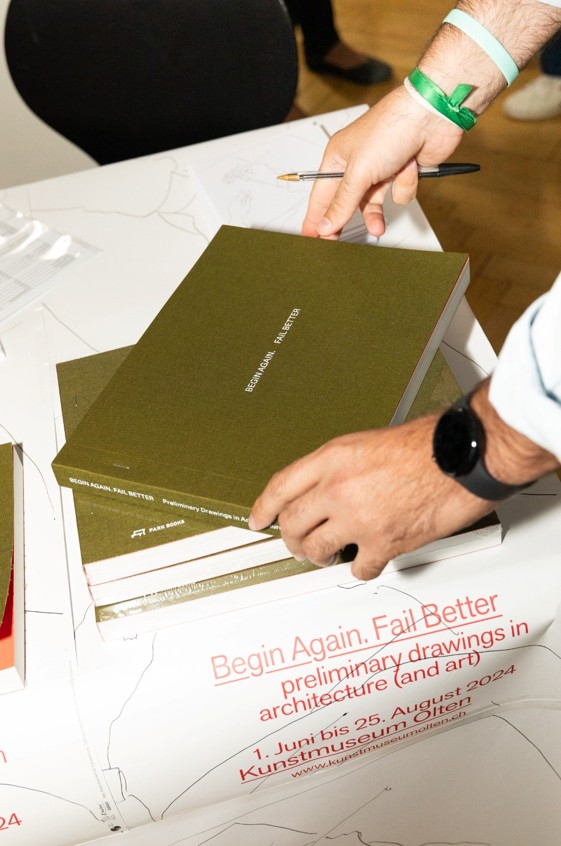
[13] Photograph of Manuel Montenegro at the finissage of the exhibition [25 August 2024] held at the Kunstmuseum Olten, signing the book Begin Again. Fail Better, 2024 (Source: Kunstmuseum Olten / Photograph © Rachel Buehlmann).
Bibliography
THOMAS, Helen; MESSMER, Dorothee; HERLACH, Katja; MONTENEGRO, Manuel (eds.) – Begin again, fail better: preliminary drawings in architecture. Zurique: Park Books, 2024.
Interviews
THOMAS, Helen – Begin Again. Fail Better, 2024.
BAKKER, Marco e MONTENEGRO, Manuel – Begin Again. Fail Better, 2024.
Acknowledgments
João Miranda acknowledges the support provided by the Fundação para a Ciência e a Tecnologia (FCT) through the doctoral scholarship 2024.00899.BD.