

Interview
Ricardo Carvalho
rcarvalho@autonoma.pt
CIEBA – Centro de Investigação e de Estudos em Belas-Artes. CEACT/UAL – Centro de Estudos de Arquitetura, Cidade e Território da Universidade Autónoma de Lisboa, Portugal.
Filipa Ramalhete
framalhete@autonoma.pt
CIEBA – Centro de Investigação e de Estudos em Belas-Artes. CEACT/UAL – Centro de Estudos de Arquitetura, Cidade e Território da Universidade Autónoma de Lisboa. CICS.Nova – Centro Interdisciplinar de Ciências Sociais da Universidade Nova de Lisboa, Portugal.
To cite this article: CARVALHO, Ricardo; RAMALHETE, Filipa – Interview with professor and architect João Belo Rodeia. Estudo Prévio 27. Lisboa: CEACT/UAL – Centro de Estudos de Arquitetura, Cidade e Território da Universidade Autónoma de Lisboa, december 2025, p. 2-19. ISSN: 2182-4339 [Available at: www.estudoprevio.net]. DOI: https://doi.org/10.26619/2182-4339/27.1
Received on May 5, 2025, and accepted for publication on June 30, 2025.
Creative Commons, licença CC BY-4.0: https://creativecommons.org/licenses/by/4.0/
Interview with professor and architect João Belo Rodeia
We have with us João Belo Rodeia. Architect, professor at DA/UAL for more than 10 years, with extensive experience in teaching, research, architectural criticism, institutional positions, and collaborations with architecture studios.
How did your architecture studies begin? Who were the professors who influenced you the most, and how did your passion for History of Architecture begin?
Architecture was not love at first sight. It was not a usual choice for those with no family connections to the architects’ environment, let alone for a boy from the small city of Leiria like me. Architecture emerged as inclusion of parts; I wanted to be archaeologist, I enjoyed History, I was drawn to buildings. And at one point, somewhat influenced by my mother, Architecture became a possibility. She arranged a meeting with architect Camilo Korrodi, which proved to be a turning point. The architectural books we had at home were also important. I recall vividly the two volumes of Arquitectura Popular em Portugal [Popular Architecture in Portugal] and Maneira de Pensar o Urbanismo [Looking at City Planning] by Le Corbusier, which were somewhat premonitory. I made up my mind and entered the Department of Architecture at the Lisbon School of Fine Arts in 1979. Three years later, my sister Teresa also entered the school. Our case must be unique back our hometown.
The school was still very inbred. I was coming from the outside, I knew no one, and I felt a bit lost at first. But I easily adapted and made friends. I zigzagged through the course over the five years, I made good and bad choices in terms of Project professors, but I made the most of my learning experience. And some of the professors stayed for life, significantly influencing me, such as Manuel Tainha or Daciano da Costa, who taught Drawing, like Fernando Conduto, or even Francisco Silva Dias, who taught Urbanism, or Sérgio Infante, whom I had in my final year, when I chose the heritage option for Project. Some History and Theory professors, such as Horácio Bonifácio and Michel Toussaint, were also important. Or Maria Calado, with whom I did not have classes, but was a reference for me.
The teaching of History of Architecture covered the High Middle Ages up to the 19th century, with a brief overview of Classical Antiquity and almost no reference to the twentieth century and the Modern Movement (which was frowned upon in school at the time). The contents were taught independently of each other, unrelated to the Project, rather than what we do here at DA/UAL. Above all, the contents were quite interesting due to some of the professors; it was a good group of professors. I already was keen of History, and History found me.
I think I was lucky with the school in the early 1980s. It was an intense time with many cultural events, some of which I helped organise as a Student Association board member and a kind of student representative on the School Board. It allowed me closeness to the School Board and some openness to Lisbon architects environment.
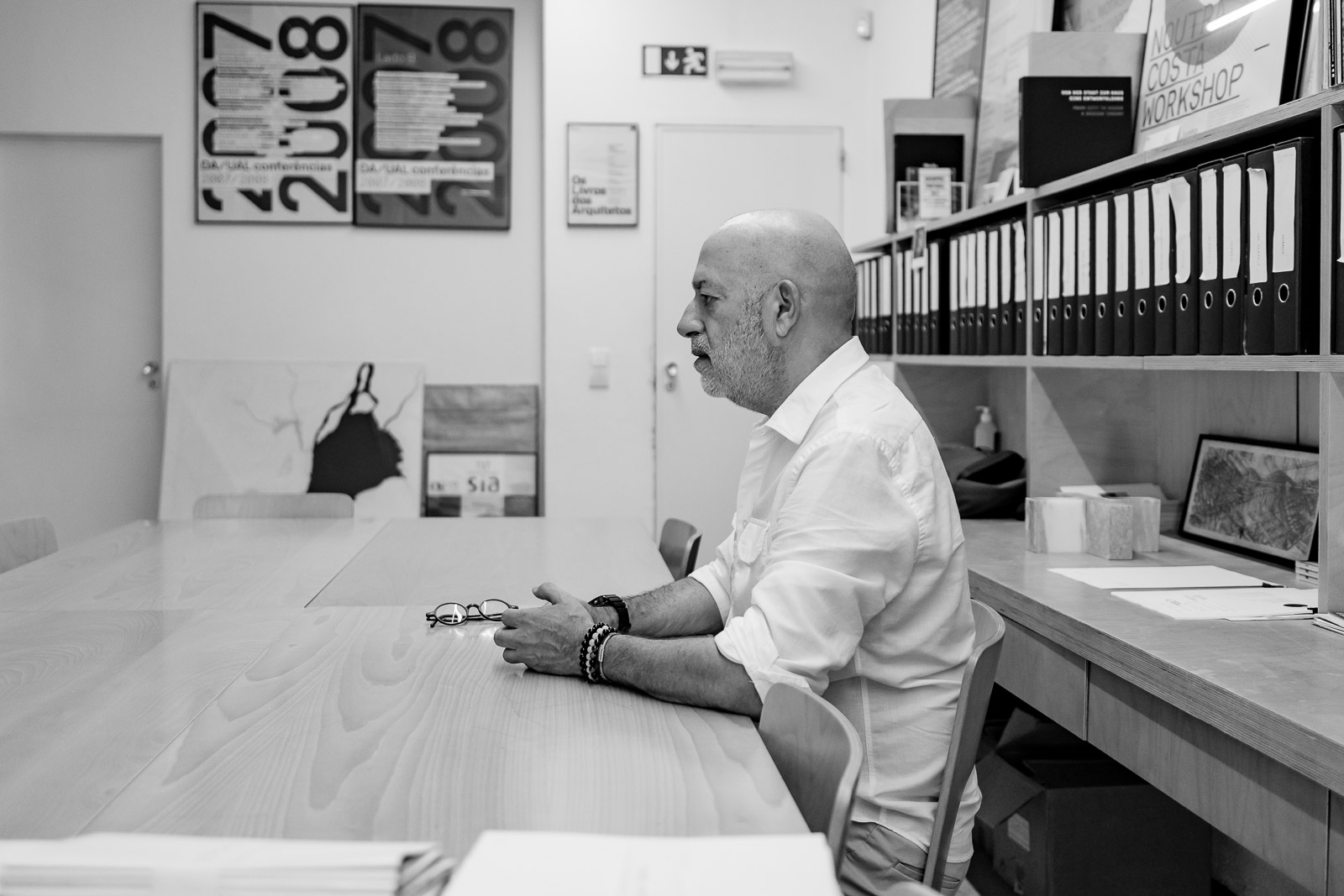
© Gonçalo Henriques + Estudo Prévio
Then the unexpected happened. As soon as I graduated, the school director, Professor Augusto Pereira Brandão, invited me to be an assistant trainee, which changed the course of my life. I did not return to Leiria; I stayed in Lisbon and did not leave school. And I committed to teaching; I started with Theory of Architecture almost without a network, initially with some help of Maria Manuel Godinho de Almeida.
None of this was planned; I was lucky again, although my academic performance was a contributing factor. Only later did I begin teaching History of Architecture, first at Lusíada University, then at Évora University, and now at DA/UAL. I remained, thus, with the two loves of my life: Architecture and History of Architecture. And teaching has become my haven, my backbone, a passion.
The Faculty of Architecture was in Chiado, in the School of Fine Arts in Lisbon historical centre. Was there a relationship between the teaching of Architecture and the teaching of Fine Arts?
Of course, the teaching of Architecture was viewed as within the field of Fine Arts, and Architecture was considered an Art. I recall vividly the first Project exercise in my first year with Professor Frederico George, which was to draw the classical orders using a ruling pen, a nightmare. Yet, there was no link with the painting and sculpture courses. We met occasionally, but we did not take advantage of our closeness. That was a pity. From time to time, I would cross the corridors where the painting and sculpture classes were to peek what art students were doing.
At the Faculty of Architecture, the first half of the 1980s was a dramatic period from the perspective of architectural culture. You and some other professors embodied a more erudite approach to architecture, rather than the drifting mood and exuberant approach that prevailed. But when we hear you talk about these years, you are never very critical; you always mention positive things. Would you like to share with us a little about what was happening inside and outside the school, and how that experience influenced and shaped you?
I always prefer to talk about the positive things and the positive aspects of things. It was thanks to the school that I became an architect and professor of architecture. And I am a grateful person.
To understand the Lisbon school in the first half of the 1980s, it is essential to recall that it had been closed after the revolution of April 25, 1974, and that its reopening in 1976 occurred in a somewhat precarious manner. When I was a student, I never thought the school was in a drifting mood; I did not have enough critical distance, the exuberance was on the agenda, and Professor Tomás Taveira was a key figure. The single possibility of comparison was with the Porto School of Architecture, which was far away. And there was a kind of malaise between Lisbon and Porto schools that was instilled on us.
I just considered I was witnessing the beginning of something positive due to the numerous events within the school, so many activities, conferences, exhibitions, and so on. In the Lisbon desert of architecture, when information was so scarce compared to today, it was fantastic just to be able to enjoy all that. With few exceptions, master Manuel Tainha was an exception, I was trained under extreme postmodernism; it was a festive, effusive school, with a lot of formalism, it’s undeniable.
Indeed, the Lisbon school never had a clear perspective of itself; the only clear perspective was to be against Porto. While there were only two schools of architecture in the country, things generally worked out. As more schools opened, the problem increased. The Lisbon Faculty of Architecture was, and remains, the most important heir of architectural education in the southern part of the country, it has an extraordinary legacy. Nevertheless, it kept this fragility, has not taken a clear perspective on itself, on its model, on Architecture. Perhaps this is due to its large size and the weight of its past, with so many and different professors. Of course, this view on the school came later, it was not my view in the 80s. Even when I was already a professor, I thought the school would improve and that I could modestly contribute to that. I did my best.
However, an interesting phenomenon emerged: gradually, the Faculty of Architecture began to have one of the highest entry averages in the country. And what eventually happened was that the school did not realize that it had students with enormous intellectual capacities, which led to a kind of parody, because the mediocrity that pervaded was unable to see the quality of its students. How did you feel before these highly qualified students, considering that drift and exuberance of the school?
Let me add something. In the 1980s, the school was in the old Convent of San Francis, in Chiado, in the heart of the city, at a time when Lisbon was awakening to a more cosmopolitan cultural and playful reality. This was a plus. It was the glorious era of Bairro Alto, with the bar “Frágil”, the “Manobras de Maio” fashion shows, and countless extraordinary events. Many of us, students, and some teachers such as Manuel Graça Dias or João Luís Carrilho da Graça, participated directly or indirectly in this collective awakening, engaging with the city and its events. Then, the school moved to the neighbourhood of Ajuda, and this new location did not help it; no longer could interact with the heart of the city. That is when I went to Barcelona, where I stayed for almost two years. I always say that I have a double degree in Architecture, one from the school and another “self-taught” due to my teaching commitment after 1985, which was in a way completed in Barcelona.
This is important to answer your question. Let me tell you that I have never been aware that I was that different, or erudite as you say, when compared to the other professors. I was 23 years old when I started teaching, I was very young, very inexperienced. I had to work a lot, studying, researching, selecting a contents body, choosing bibliographies, and questioning myself how the classes of Theory of Architecture could be captivating and useful to students. All without a network, on my own, I had a lot of freedom.
Step by step, I defined the classes of Theory of Architecture as organisation of space considering the architectures of history, critically deconstructing twentieth-century projects and authors. I thought and I still think that this knowledge was vital in itself and for the Project. So, the foundational modernity of the 1920s and 1930s thus emerged very naturally and inevitably, although it was rarely discussed in the school at the time, and when it was, it was in a negative way. This did not take place at once; it resulted from maturation and fine-tuning over time, less and less casuistic. The desire for the foundational modernity made me more mature in its understanding, and gradually I moved away from the exuberant mainstream of the school.
At the same time, I looked for the students wonder: teaching with empathy is essential; you cannot graduate and be an architect without wonder. I overcame my endemic shyness and learned how to teach in a rather more intuitive way than a rational one. The truth is that the students enjoyed my classes, which were always full, and I think they recognised my commitment. I started to organise study visits on Saturday mornings, beyond school hours, always full of students. From time to time, I invited “outsider” architects, such as Gonçalo Byrne, to give small lectures; and I launched research on forgotten architects, such as Celestino de Castro, Ruy Athouguia, Victor Palla, Joaquim Bento de Almeida, Francisco Conceição e Silva, Maurício de Vasconcellos, and many others.
Nevertheless, I never taught for the most qualified students; I always taught for all the students. Of course, this never meant lowering the demanding level for myself, for my classes, for the students. The school, any school, should not exist as “more or less”, it must aspire to be excellent; only in this way can it train good and very good future architects. This is the mission of an architecture school, it exists for the students, for the excellence of their training, not for the careers or careerism of the professors.
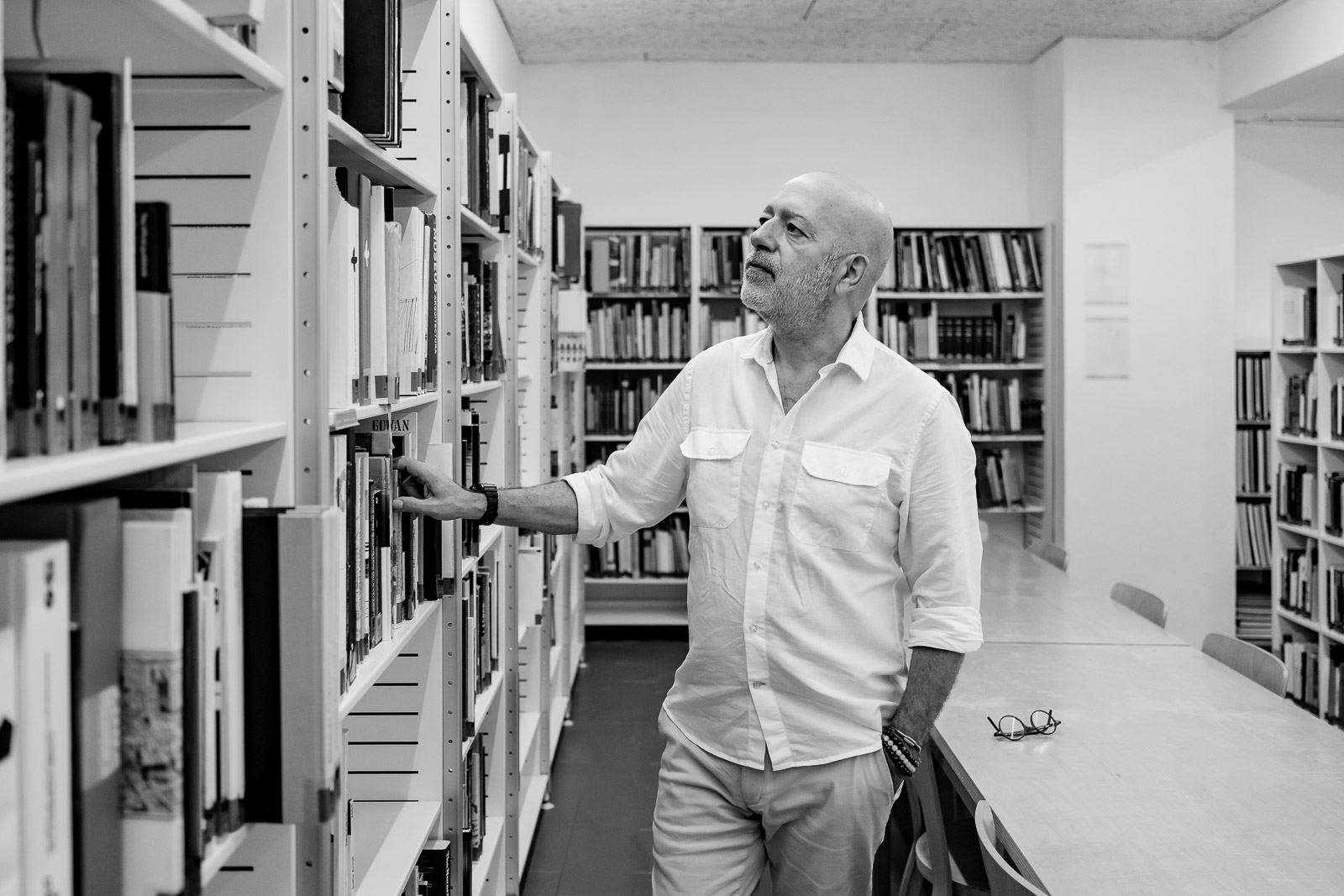
© Gonçalo Henriques + Estudo Prévio
I do not know quite well what is happening today at the Lisbon faculty, I know that the great masters of my time are no longer there, I know that its academic complexity has increased, I know that there is some distance between its Project’s teaching and the best Lisbon praxis, but I believe that it has committed professors, I know some of them. Perhaps the most qualified or most attentive students seek to zigzag among the best Project professors. Some will be better trained, while others will not, just like it happened in my time. But the fundamental issue remains: the school model. Perhaps there is or will be a younger generation of professors to make the necessary change.
What is your first critical text on architecture?
My first text with some impact was “O Fim da Inocência” [The End of Innocence], it was published in a JA (n.º 106, December 1991) and brought me some annoyances. The text considered the future of the Lisbon and Porto architecture schools, among other matters. I was called to the Lisbon school board, they believed I had disregarded the school. And Alexandre Alves Costa, whom I greatly admire today, wrote a text in the magazine Unidade that began with my name and proceeded to defend the Porto school. It brought me some notoriety, something I didn’t have at all.
And what was that “end of innocence”?
As far as I remember, the text tried an assessment. We were in the early 1990s, the condition of the world was different, the Portuguese context as well, Lisbon and Porto were more cosmopolitan, there was more information, more internationalization and Álvaro Siza, more schools, more students, more architects, the Association of Portuguese Architects was ceasing to be a kind a family club, everything was changing, there was a climate of change. And the two main schools remained unchanged: one more open but lacked substance, the other with substance but more closed. In my opinion, neither one nor the other was preparing to face change; neither was the Association of Portuguese Architects. Seen from a distance, it also marked the end of my own innocence.
We can continue on this subject of critical thought. You were involved in an exhibition on Portuguese architecture at the Mendrisio Academy of Architecture and this experience gave rise to a text called “Precisões” [Precisions], which was later published in JA in 2000. It is a text dedicated to Michel Toussaint, where you say that: “The purpose of architecture is not to be in itself, but above all to understand the foundations and procedures that generate the projects and the transformations that they operate, seeking to build places where men live and meet.”
This text does not overlook a certain distinctiveness of architecture made by Portuguese architects. This is an issue that has been questioned in recent decades. And the question is, does it still make sense to talk about a Portuguese architecture?
The architecture that interests me the most is the one that, because it is disciplinary, because it knows how to think itself in this way, brings about transformation, hears the world and seeks to improve common life.
As for the question… it is a good question to which I have never had a clear answer. The text originated from the 1998 exhibition in Mendrisio, which I curated, and was read as the opening of two conferences: one by Eduardo Souto de Moura, another by Manuel Aires Mateus. To the text I added images from the volumes of Arquitetura Popular em Portugal. I recall vividly the packed auditorium, with Aurelio Galfetti and Mario Botta seated in the front row. What a responsibility! It went ok, though.
I spoke of a double condition, the condition of the world and the condition of Portuguese architecture, or rather, of a Portuguese architecture. The former had to do with the disarray of the world and the awareness of its finitude, among significant challenges such as social and planetary asymmetries, consumerism, resources scarcity, pollution, technological obsession, growing urbanisation, and the lack of adequate inhabiting. All this was said 25 years ago; it seems today.
And the latter had to do with the circumstances of our island country, the peripheral contingency, the geographical diversity with the Atlantic and the Mediterranean, the topographical ancestry of its cities, the built history, the condition of scarcity, the ability to sublimate foreign information, and so on.
And there would therefore be a modus operandi recognisable in many Portuguese architects, a shared knowledge of gestures or poetics. This is evident, for example, in the importance given to the “place” in Project processes; Portuguese architects, when discussing their projects, tend to start by the “place”. This was the context; it seemed wise to talk about a Portuguese architecture. And, given the condition of the world, it seemed to me that this architecture possessed an enhanced ability to deal with any situation anywhere; it carried this relevance.
In the end, because of the projected images, Eduardo told me: “Is this all from Arquitectura Popular? I have to look back at the book.” Arquitectura Popular em Portugal portrays a country that has already vanished, an architecture that has already disappeared, a harmony between land, people, and construction that has also vanished. It has disappeared, but it whispers; it reveals this Portuguese circumstance, which is very inspiring. However, as usual, those who recognise it most are those who see us from out of borders, whether in a positive or negative way, not so much the Portuguese.
Have you changed your mind?
No. Some people disagree with me, and there are other architectures in Portugal. Yet, this circumstance, geographical, historical and cultural, in a country where poetry has always replaced philosophy, continues to influence the doing and thinking of architecture among many Portuguese architects of different generations, even under evolution and in different expressions, even if they are not aware of it. It is a contingency that will only disappear if the country’s geography, history, culture and language disappear.
But this observation, combined with Eduardo Lourenço’s perspective, whom you quote in several texts, was it not also a means to resist postmodernism?
Maybe it was, but the end of my innocence preceded that resistance and my Portuguese observation. I moved away from the world of formalism through a lot of self-criticism and self-effort; I had had enough, I found it impossible to follow. Let us be clear: I was trained in this world, I was immersed in it, and I thought it was the way. Discovering foundational modernity disturbed me, made me think otherwise, and showed me another path. Many people know that I started with Le Corbusier at a time he was not discussed anymore, at least in Lisbon. A fascinating character, a tireless inventor. As Alison and Peter Smithson said, when you thought you had discovered something new, you would open Oeuvre Complète, and it was already there. In 1990, I did pedagogical and scientific skills exams on Le Corbusier. I ran a calculated risk at the time, as research did not have the tools available today; information was difficult to get, and I was doing the exams in a post-modern school. Despite all that, it went quite well. Then I started researching Aalto and Mies, then many others. Afterwards, I transitioned from authors to themes that interested me. And then I focused on many other times in history. Being exposed to other ways of thinking, travelling, and doing advanced studies in Barcelona broadened my horizons and expanded my perspective.
José Ferreira Junior, a friend of my parents and our doctor, who had been a communist like some of my family members, told me, as a joke, that one could only be a social democrat or a social-liberal after being a communist. Perhaps I had to be post-modern to be able to rediscover the modern project; and your beliefs only change if there is a strong conviction. First, I rejected formalisms, although there are post-modern projects that interest me and that I like, I keep my mind open to everything. Then I realised the dead end of the micronarratives, now so prevalent, sometimes very interesting or pertinent, but that do not want or cannot have a cross-sectional view of the world, of history, of life, of architecture. That’s not my beach.
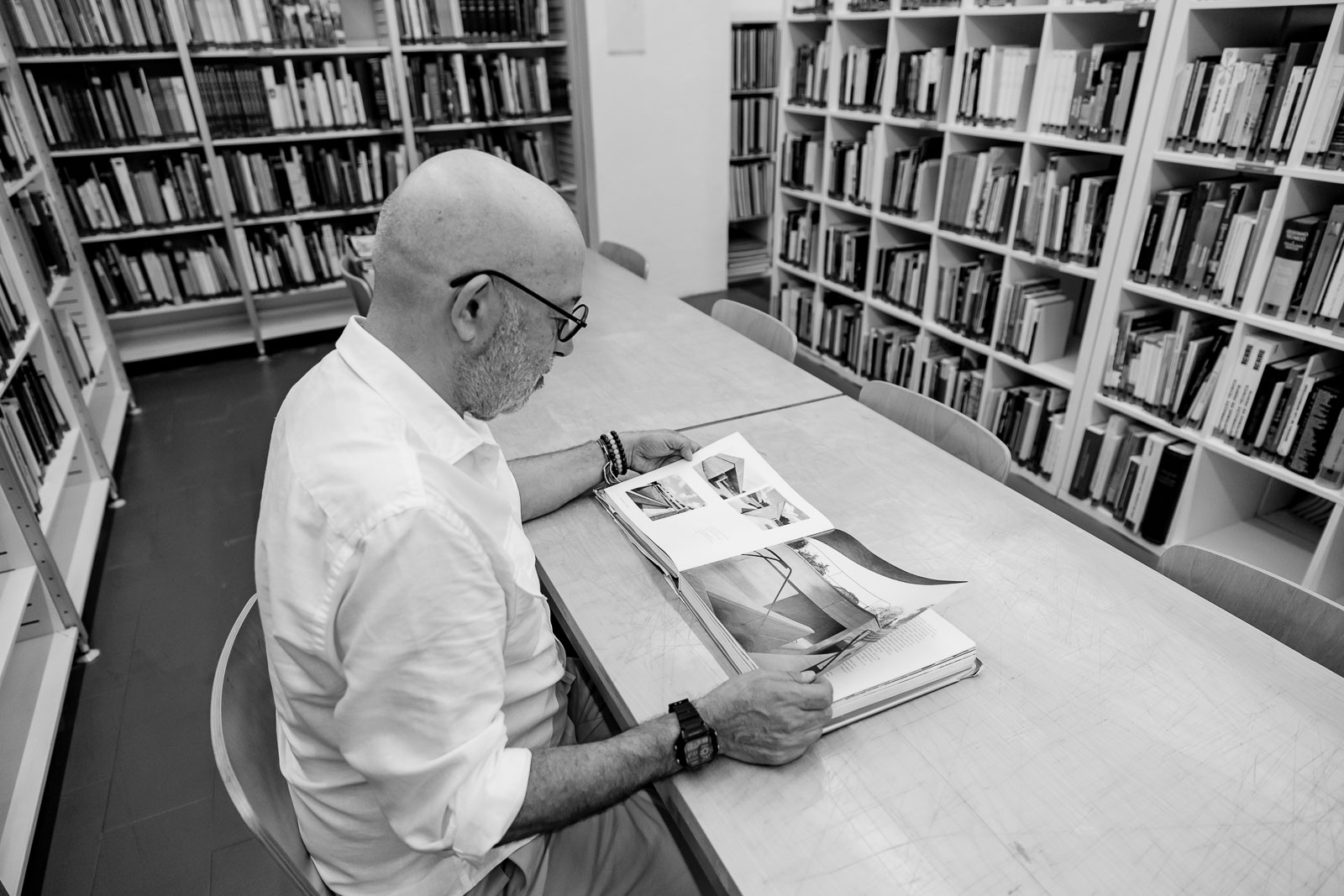
© Gonçalo Henriques + Estudo Prévio
Seen from a distance, the architectures of history, the architectural culture, and the contacts with other worlds, mainly Brazil, as well as a growing closeness to the modus operandi of many Portuguese architects, especially the youngest at the time, forced me to rethink architecture, including Portuguese architecture, and to rethink it in a broader perspective.
When we talk about Portuguese architecture, we refer to an erudite production, but one that has a vernacular basis. This recognition is now more evident than it was a few decades ago. Do you think that not being a city person has helped you to better understand this situation?
Maybe, I never thought about it. Let’s see, I am not from Lisbon, but I am a city person, I was raised a city person. Unlike most kids I knew, I was lucky to travel around the country with my parents from a very early age. There were regular visits to the family on my paternal side, who are from Alentejo, and to my maternal side, who are from Ribatejo, as well as visits to my godparents, who lived in Santarém or occasionally on their agricultural estate in Ponte de Sor. We spent our holidays in São Pedro de Moel and the Algarve, travelled occasionally to Funchal, and visited the north of Portugal and Spain almost every year, as well as Lisbon many times a year. My mother had lived in the capital until getting married and could not stand the smallness of Leiria full-time. I also spent some time outside the city. My maternal grandparents returned from Lisbon to Serra de Tomar in the late 1950s, and had a rural, modest life. I had this very comprehensive experience.
Despite the privileged education, my parents never hid the fact that many struggled to survive in the countryside and in the city, lots of people having nothing and widespread poverty. There were other realities, other lives beyond our own and those of our friends. This is what influenced me the most.
Perhaps it has given me a certain ability to question Portuguese architecture, and surely the conviction that architecture is for the “greatest number”, it has the obligation to improve common life.
Everyone knows of your passion for the Modern Movement and its masters. Which is associated with the hypothesis of wide model reproduction. In the Catalan magazine 2G, in issue 20 (2001), of which you were the editor-curator under the theme “Portuguese Architecture, a new generation”, you stated that: “The architectural project is an approximation, identification, questioning, clarification, ambition and answer.” Is each project unique?
It is not only passion for the modern project, but also accession, although in a contemporary frame, in a different time condition. The modern project as better city, better public space, and better dwelling for all has never been fulfilled. Hence, repetition, the same project generating a series of projects, is inevitable. Also, the reproducibility of the project, in fact the architectures of history reproduce themselves and are reproducible. Each project is oneself and some others.
I assume that, since a project is a process and has a specific origin, this origin generates the question of how the process develops to attain its precise “end”. And, if so, one could admit that each “end” is always different. However, as we all know, different authors, if faced with the same origin, will develop project processes that can be grouped into similar families of response. There is this repeatability, this circumstance.
Most likely, because one never starts from scratch, memory exists. It may be the intimate memory, the one that Zumthor speaks of. However, the memory that interests me most is disciplinary memory, the architectures of history in the art of memory, the imaginary museum of architecture, the one that can be a resource for thinking and doing Project, because situations repeat, gestures repeat, there are always situations of the past that can help or determine, in whole or in part, similar situations of the present. I think it is quite foolish not to take advantage of this inexhaustible disciplinary resource. This is the reproducibility that interests me the most. Each project is oneself with all the others that are alike.
I raised this question because one of the conceptual forces of the so-called post-modernity, especially in the famous book by Jean-François Lyotard (The post-modern condition), is precisely the idea that the grand narratives are over, and that what could be done, I am freely quoting, was “writing on the margins”. What you propose, which is beautiful and very poetic, can also be understood from this perspective. That is, it can be understood from the perspective of the grand narrative, as you thought, but also from the perspective of the postmodern narrative. Do you agree?
I do not reject that possibility. Of course, I accept the fragment, but the margins do not exist without the river. I remain convinced that one can create grand narratives on the human adventure, on our existence on Earth. And, therefore, I remain convinced that one can create grand narratives on Architecture, the disciplinary field of common inhabiting, a disciplinary field that listens to the world.
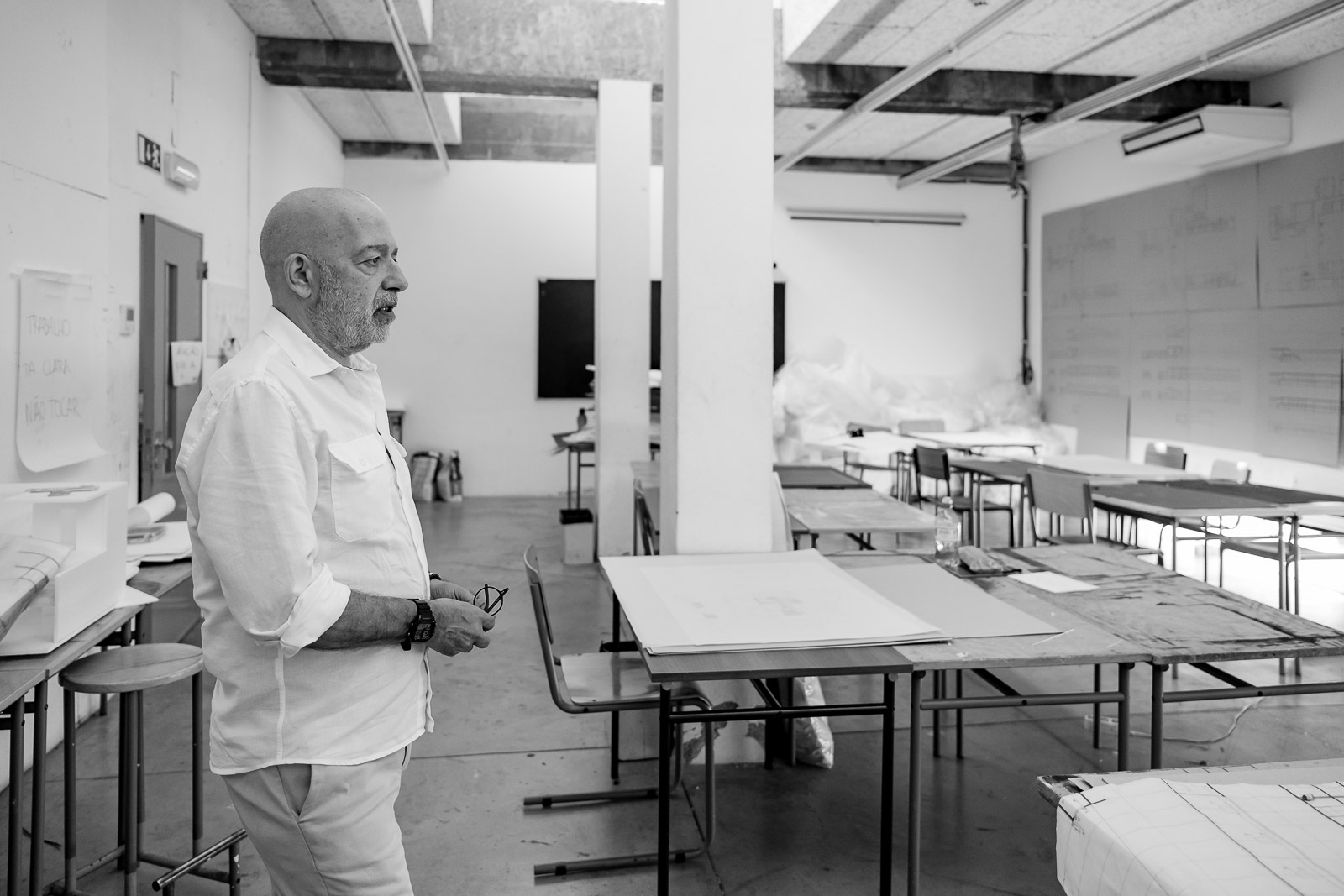
© Gonçalo Henriques + Estudo Prévio
The micronarratives only make sense within the effort to understand the whole, in the possibility of the grand narrative. I have long been suspicious of the autonomy of micronarratives, and there are so many today, sometimes so unintelligible, so blaring, so not operative. They just deconstruct; they do not go anywhere; they are dead ends.
And to what extent is the written text relevant in this context? Or can the building itself be a position?
The building itself can obviously manifest a position, look at Paulo Mendes da Rocha. In fact, architects are not trained to write; few are as skilled as you, Ricardo. Although writing, associated with the Project, allows you to precise ideas, precise positions, explain processes, justify ends… it helps to do and to think, and, at the same time, to share with others. And, at a later time, it helps the reflection on what one has done.
Then there is the specialised architectural criticism, essential for assessment and contradiction, although nowadays, with so many Towers of Babel, everything is instantly lost, and it is very difficult to overcome a kind of prevalent acritical horizontality. Additionally, there is the architectural research presented in so many publications over time, so extraordinary. There are not many disciplinary fields with such a vast and intense bibliography.
All written texts are important as the sand of the beach, the sand where we walk and choose our path.
In 2008, there was a seminar called “Portugal Hoy” [Portugal Today], curated by you, at the University of San Francisco in Quito, where you chose a group of architects from Lisbon, who went with you to present their work (Aires Mateus, Bak Gordon, Inês Lobo, Paulo David and Ricardo Carvalho). Later, this seminar led to an exhibition at the Royal Institute of British Architects (RIBA) in London, curated by Jonathan Sergison of the Sergison Bates studio, entitled “Overlappings”, which also featured João Favila. How do you see these overlappings among a group of architects whose work you have followed practically since they started?
Not practically, I followed them from the start. They were all my students, except for Aires Mateus; however, I also followed Manuel and Francisco’s work from a very early stage. But there have been many more architects, from the north and south of Portugal. Just look at the sixty-odd articles I wrote in the newspaper “O Independente” from 1999 to 2001.
The 1990s were a generous decade, during which many young, up-and-coming architects emerged. They won competitions, some of great public notoriety, such as the Portuguese Embassies in Brasilia and Berlin, or some university buildings. In some way, that was a surprise, especially for the older generations. It was within this context that, in 1999, the Chamber of Portuguese Architects invited me to organise the exhibition that I called “Geração de 90” [90s Generation], as a kind of joint manifesto. It was the very beginning of it all, including Quito. Very intense.
It was a continuum that got me involved in a critical assessment process, sometimes intuitive, risky, since choice implies risk. It implied the assessment of buildings, their relationships and their relevance both for the present and the future. I always sought architects and buildings beyond the froth of the days, those that I most anticipated would last over time. I got it right many times, I got it wrong sometimes, I made some mistakes and omissions; that’s normal. And I tried to frame the process with geography, history, the city, the country scarcity and so on. Also with the condition of the world.
The choice of Quito participants arose from this continuum. There was already previous work, it was a consequence. This time, they were all from Lisbon (plus Paulo David) because that was what the University of San Francisco had asked me. All of them had known each other for a long time, they shared complicity. And perhaps because we were all in the Ecuadorian Andes, so far away, we were able to think collectively about the next steps. And thus “Overlappings” was created.
In the meantime, I got involved in institutional activities at IPPAR [Architectural Heritage Institute] and at the Chamber of Portuguese Architects. After so much discussing and writing about the need for change, it was time to try to make a difference, it was time to act with the teams that worked so hard with me. But these are other adventures that I will want to share on another day. Anyway, I moved away from the exhibition process for obvious reasons: I could not take sides. Fortunately, the group continued. And “Overlappings” took place at RIBA, in London, where the celebration of complicity poured into architecture and vice versa.
Jonathan Sergison poetically speaks of this in the catalogue. He speaks of architects always meeting, of an unusual familiarity seldom seen elsewhere in the world. Obviously, there was also a common ground of architectural complicity. The name “Overlappings” was very assertive, meaning the project dialogue between everyone through the exhibition layout. Six wooden chests were designed by João Favila, all the same, an allusion to the old sugar travel chests from Madeira Island. Inside each chest was the work of a participant. When they were closed, they already shared a common ground. When they were open, the identity of each participant was made evident, both inside and outside the common ground. As in any overlap, there was a shared area, all together on the same path, and the specificity of each participant, the sugar of each travel chest. It was very beautiful, very powerful. From London, the exhibition went to other European cities. And it could continue to sail, the chests would be the same, but the contents would change, always under the same concept and exhibition purpose, a poetic but objective overlap.
Do you realise the description you just did at our school? These architects were or are all professors at DA/UAL.
Obviously. This complicity shifted entirely to DA/UAL and joined the existing school complicities in an extraordinary harmony. Well, I must be careful with my words, because I may be biased, but I have to say that I have never encountered anything similar in any of the schools I have taught.
I would like to add something else. We know that this school was born from a split, stemming from a distance with the Ajuda faculty, and the founders’ search for a more engaged teaching model: José Manuel Fernandes, Manuel Graça Dias, João Luis Carrilho da Graça, then Manuel Aires Mateus. This group and its school proposal were warmly welcomed at UAL and soon joined by some of the most relevant architectural praxis of Lisbon. I feel comfortable saying this because I was still out of DA/UAL.
However, by coincidence, this school embodied and incorporated many of the best architectural legacies of the capital and the south of Portugal. João Luís, still very influential at DA/UAL, is related to post-war radical modernity of Lisbon, although he goes far beyond this affiliation. Manuel (whom I dearly miss), the school’s first ideologist, was related to Manuel Vicente and similar architectural praxis, including José Daniel Santa-Rita. The brothers Manuel and Francisco are related to Gonçalo Byrne and a genealogy that goes back to Raul Lino, Carlos Ramos and Nuno Teotónio Pereira, although in a different and contemporary context, including authorship. Even José Manuel, although less present, is related to Francisco Keil do Amaral. In other words, DA/UAL turned to be the meeting place for prominent praxis and legacies of Lisbon architecture, a “Lisbon school”. This scholar body welcomed the complicity of “Overlappings” in a new overlap, in a common adventure. In short, when we discuss architecture, we all know what we are talking about; there is common ground, differences that respect and complement each other, a school with a model and a position although in permanent change.
Today’s school is not the same as it was 27 years ago; it’s not even the one I found 10 years ago. Or rather, it is the same in its permanence and its change. The Project is at the core; excellence in students’ training is the first concern; the excellence of the Project professors is inseparable from exemplary professional praxis, because DA/UAL was and is thought for students and future architects. And, instead of what we sometimes hear, it is a school with open doors, open to the outside, open to the best of contemporary architectural culture, open to the world, aware that architecture schools are the last strongholds to think and propose systemic changes for cities and collective inhabiting, to think and propose better futures. DA/UAL is a school of resistance and proposal. For me, it is a joy to participate in this adventure.
© Gonçalo Henriques + Estudo Prévio
Your journey has a lot to do with curating, which involves making choices. DA/UAL was founded that way. João Luis Carrilho da Graça, Manuel Graça Dias and José Manuel Fernandes had the courage to choose a group of people, which later expanded. I see your work from the beginning of the 1990s as being unafraid to state a purpose and being intellectually coherent. Your choices were never diplomatic; they were disciplinary. Each of us has processes of intellectual empathy, also of taste, but I associate your path with this rigour.
Yes, my choices were always disciplinary, sometimes also diplomatic, meaning not to let intellectual empathy or taste distract the rigour and balance of the whole.
It is worth noting that, in the 1980s and 1990s, architecture curatorship was scarce in Portugal. And disciplinary curatorship was even scarcer, perhaps except for Ana Tostões and the exhibitions associated to the Porto school, which knew what they were there for. There was a positive thing: the curators were architects connected to disciplinary praxis; they were from the inside field. That was my case as well, and that helps a lot, even after I left the studio in the late 1990s. Nevertheless, at the time, the curators rarely took a stand.
Everything or almost everything fit, at least that was what it seemed to me. Once again, although I was very inexperienced, I knew that was not how I wanted to do it. I was lucky. After the first attempts at the Clube Português de Artes e Ideias [Portuguese Club of Arts and Ideas], my real possibilities of curating emerged well beyond the end my innocence; I was more confident, mature, and capable. Let us say that I was more serious, but I never took myself too seriously. It is essential not to take ourselves too seriously, because otherwise, attention to others decreases, bridges fall apart, and we close ourselves off.
I also knew quite well many of the then-young Portuguese architects and their work, who were inseparable from the core of much of my curating. The possible merit of my choices arose from the merit of their work, they had proof given. The merit and success of their work did not arise from mine, and this must be said clearly. I am glad that was the case.
In teaching, choosing what to teach students is a political act. Fortunately, you could make your choices, perhaps because at the time no one was paying attention.
Yes, that is true. However, and let me reiterate this, I was given total freedom at the faculty, and I never felt any animosity. There was one single ridiculous complaint to the School Board by someone who thought that my “modernity” disturbed the teaching of Project… can you imagine?
My scientific tutors, first Professor Augusto Pereira Brandão, then Professor Maria João Madeira Rodrigues, never asked me to change anything, I am very grateful to both. At the age of 23, I started to create my own path, free to leave and get as far as I could. And once again, although I was attentive, very little was premeditated, everything just happened.
In fact, the role of the professor is increasingly to make this choice, because all information is more than available. How do you think about these choices today? What should architecture teaching be like today?
The choices depend on how we use the lenses we have to see and what we want to achieve. If you ask me if I teach differently than I taught 30 years ago, of course I do. If you ask me if the contents of what I teach are different, it would be a terrible sign if they were not. The contexts are not even comparable. Still, after I started, there was a path, and that path was more stable over time than it might seem at first. Just like the river that is always the same and always different every time we go in, because the water is no longer the same.
Of course, today I carry with me many years of teaching, much more knowledge, greater transversality in history, and I am more at ease in many subjects, more structured in everything. Of course, today the tools are different; the digital world has brought extraordinary possibilities, constant flows of information. Interestingly, my didactics remain very similar, as I have already mentioned. I am still committed to the students’ enchantment, to their wonder, and I strive to encourage their active participation; I do my best. I present and comment sets of projects and themes, foster dialogue, ask questions, walk through the classroom… My approach is somewhat intuitive, a bit improvised and almost as in a workshop.
The History of Architecture in an architecture school cannot be a history for historians; it must be a history for future architects. I am more interested in buildings telling their stories and history; I am more interested in talking about the architectures of history. It is an approach to specific historical eras and to their specific knowledge, but it is, above all, an attempt to analyse projects and themes overtime; it can be the Pyramids of Giza or the House at Butantã by Paulo [Mendes da Rocha]. I look for similar architectural guidelines of critical assessment for any fact in any time; I try to reveal thought, spatial organisation, construction and materiality, type-situations and so on. Hence the enormous potential for the Project processes, an imaginary museum to feed the Project. But do not think that because I know more, my effort has decreased. I learn a lot from the students, and I continue to research, prepare classes, read books, and questioning myself. There is always something more to discover, other ways to teach the same things or different things for new situations. It is a restless mood. The river is always different, although its bed remains, even if it changes over time.
There is a book that you like very much, “The Secret Lives of Buildings” by Edward Hollis, which tells the history of some buildings of Western civilisation as if the buildings themselves told their histories (the Acropolis in Athens, Hagia Sophia in Constantinople). I see your work and understand why you like this book so much – on the one hand, you talk about the architectures of history; you focus on the disciplinary field; on the other hand, your knowledge is very erudite. You can integrate the various “rivers” and their confluences, as well as their “dams” and “dikes”. This perspective of grand narratives, which you never relinquished, defines your position as a thinker and professor of History. And, of course, as an architect. When you served as president of IPPAR, from 2003 to 2005, you compiled a list of architectural projects built in Portugal during the 20th century for heritage listing. This process is already underway and has been listing several works, some as National Monuments. What is contemporary heritage in your opinion?
Since Ricardo has not kept the secret, I would like to add something. Edward Hollis, an architect and professor in Edinburgh, worked with Geoffrey Bawa and is not a well-known reference in the History of Architecture. But he does a very beautiful thing – he links architecture and storytelling in History and, as he says, he spends much of his time encouraging students to read, understand and reveal the stories and history that buildings have to tell, the stories and history built by time, and the times of built stories and history. That is wonderful. I wish I could do it as well as he does. And above all, the relationship with the Project process is very relevant. Additionally, I am somewhat jealous of his training. At thirteen, he decided to attend the Jesuit Stonyhurst College and escaped from rugby to hide in the school library with the ducentist compilation Legenda Sanctorum by Jacobus Voragine and a seventeenth edition of Quattro libri Dell’Architettura do Palladio… amazing! Then Cambridge University, Scotland after.
© Gonçalo Henriques + Estudo Prévio
Now, I’m going to answer your question. I decided to move forward with three listings of Portuguese buildings, one from the 20th century, another from the 19th century, and a third featuring landscape architecture. I listed the first one; it was easier for me and it was relatively fast, although much work had already been done by IPPAR’s research department, particularly the one coordinated by Ana Tostões. In fact, I reactivated IPPAR Advisory Board with a group of people who, besides Ana, included Aurora Carapinha, Maria Calado, Claudio Torres, Antonio Adão da Fonseca, Fernando Real and some others. It was an exceptional group that would help with these tasks. But it was not possible to do everything I wanted; there simply wasn’t enough time.
All these listings were focused on times and disciplinary contexts with very few listed buildings. In the 19th century, and above all, in the 20th century, a lot of construction was carried out compared to previous times in Portugal, generally in more recent urban areas, more volatile due to replacement and speculation; an urgent response was needed. However, only the 20th-century listing was completed, and I opened many listing processes in the final stretch of my shortened term. Some have been continued, while others have not. I do not know why… But many went through, which is excellent.
The Portuguese word “Património” comes from Latin and means the legacy of parents or ancestors. It is much stronger than the English word “Heritage”, which derives from inheritance. “Património” implies family, the responsibility to preserve, care for and value this special legacy for its common value, as testimony, as something shared, as a common good. Roughly, this is what we refer to when discussing Cultural Heritage or Architectural Heritage, the most valuable legacy of a family, meaning all of us. For me, it doesn’t matter whether it’s contemporary or not.
Of course, in Architectural Heritage, the recognition of the cultural value of a recent building is closely tied to its disciplinary value and its relevance in the time it was projected and built. However, it can also arise from a non-disciplinary context, such as an extraordinary event or a historical fact associated with the building, for example. In any case, the closer to us, the greater the risk of this recognition, because the time distance filters a lot, it helps critical assessment.
Nevertheless, the heritage listing of contemporary buildings remains possible, legitimate, and urgent; the speed of substitution is relentless. The listing is always fluid; it can be adjusted in the future, just as a building can be listed, it also can be out of listing if justified. There must be research and knowledge for critical assessment and cultural recognition. And one needs to be determined to do so.
Again, the courage to choose.
Let’s see… I think “courage” is a behaviour that has to do with firmness in the face of adversity or intimidation. I have never seen my choices through this perspective, even when there was risk, and there is always some risk. I chose out of conviction, with reasonable certainty after much thought and dialogue, also with some intuition, finally with determination. I don’t choose because I am or I want to be brave; it’s not something I think about when I make a choice. I choose because I am convinced that it is right. Then, if courage is needed, so be it. Courage is less complicated when we are convinced we are right.
One quarter of the 21st century has already passed. When we talk about these choices and this contemporaneity in the teaching of History of Architecture, what do you think can be the future of teaching a history of contemporary architecture?
I am not very concerned about it, perhaps because today my lens encompasses 5,000 years of architectures through history. The future will be the future, and it will be a natural part of the immense river of history. One thing is sure: those who teach must genuinely enjoy teaching and be aware that this passion is to be shared with their students. It all comes down to this.
You must be fully committed. I am not making conventual or monastic apology, but you must be fully committed. Only this way can the architectures of history remain a relevant path for the Project and the future of future architects. And what matters most is that the imaginary museum can meet each new era, meaning each contemporaneity. It is an endless odyssey, unlike that of the great Homer. It is an endless sailing for Ulysses.
Do you believe that these authors you have been selecting over the years will be part of future syllabi?
In my case, some already are. Not so much in History of Architecture, but in Organisation of Space. Nevertheless, their work is already part of a recent history of Portuguese architecture; it is not possible to build a narrative of the recent history of Portuguese architecture without mentioning many of these authors, some of their projects, or the whole they represent. However, if the future can be foreseen, it rarely coincides exactly with what was envisioned.
We can conclude with a quote by Heraclitus, whom you often refer to, “the river is always the same, but the water changes.”
I do repeat it many times: “No man ever steps in the same river twice, for it’s not the same river and he’s not the same man.” I gave it a little twist. The same river changes through the movement of water; the river bed remains the same in permanent change.