

Ricardo Aboim Inglez
r@aboiminglez.com
Architect, PhD student at the Department of Architecture of the Autonomous University of Lisbon/Universidade Autónoma de Lisboa (DA/UAL), Portugal. CEACT/UAL – Centro de Estudos de Arquitetura, Cidade e Território da Universidade Autónoma de Lisboa, Portugal.
Rita Aguiar Rodrigues
rrodrigues@autonoma.pt
Architect, teacher and PhD student at the Department of Architecture of the Autonomous University of Lisbon/Universidade Autónoma de Lisboa (DA/UAL), Portugal. CEACT/UAL – Centro de Estudos de Arquitetura, Cidade e Território da Universidade Autónoma de Lisboa, Portugal.
To cite this article: INGLEZ, Ricardo Aboim; RODRIGUES, Rita Aguiar – Interview with Tony Fretton. Estudo Prévio 28. Lisboa: CEACT/UAL – Centro de Estudos de Arquitetura, Cidade e Território da Universidade Autónoma de Lisboa, June 2026, p. 2-11. ISSN: 2182-4339 [Disponível em: www.estudoprevio.net]. DOI: https://doi.org/10.26619/2182-4339/28.1
Received on March 13, 2025, and accepted for publication on May 19, 2026.
Creative Commons, licença CC BY-4.0: https://creativecommons.org/licenses/by/4.0/
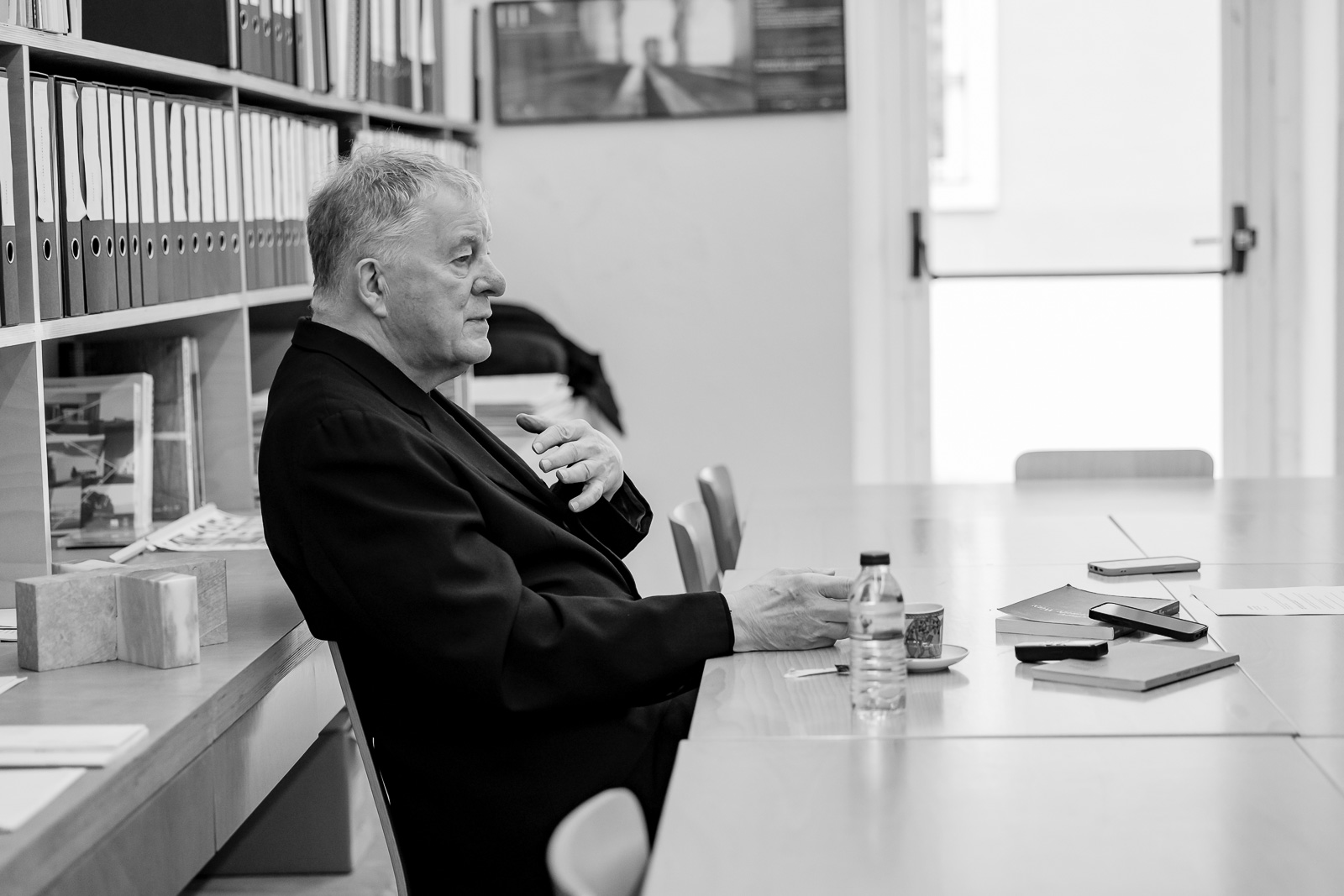
© Gonçalo Henriques + Estudo Prévio
You seem to have a strong connection to Portuguese architecture, particularly to the work of Álvaro Siza. You have written several texts about his designs and often refer to him in interviews. How did your interest in his work first develop?
I was first introduced to the work of Álvaro Siza in the mid-1980s through an exhibition held in London at the 9H Gallery — an architectural gallery established, among others, by Wilfried Wang and Ricky Burdett — which presented to British audiences the work of several continental European architects. Siza’s work was profoundly illuminating. It was strikingly different from what was being constructed in London at the time.
I recognised that his architecture was attempting to communicate something beyond the immediately perceptible — something one could sense as meaningful, even if not fully understood at first encounter. At that time, I was teaching at the Architectural Association, and I travelled with my students to Porto to visit Siza’s buildings. During that visit, I encountered the Leça da Palmeira Swimming Pools, the Boa Nova Tea House, Quinta da Conceição, and the Carlos Ramos Pavilion at the School of Architecture. The experience was revelatory.
Siza employed conventional construction techniques and their familiar lexicon with remarkable eloquence, striving to transcend the limits of the ordinary. This quality was particularly evident in the Leça da Palmeira Swimming Pools. There, one arrives beside the sea, yet no building is immediately visible — only a wall. One descends a ramp, changes clothes, and becomes more physically exposed, symbolically leaving behind the identity of a person of the city. Emerging again, the sea is still not in sight; one must turn before finally glimpsing it. The first view is of the children’s pool, which might have been built by any father for his children on the beach. Only then do one look further and truly encounter the sea.
A concrete jetty marks the edge of the pool, extending towards the horizon. To the eye, it appears to share the same scale as some of the pool’s own elements. There is, in this composition, an extraordinary intuitive relationship between the swimming pool and its industrial context — an environment in which utilitarian structures were often placed carelessly within nature, to destructive effect. In Siza’s scheme, such interventions are observed critically but not punitively; they are understood in relation to the physical and sensory pleasure of human experience.
All these aspects were deeply compelling to me. When I first visited these works, I had already designed the first Lisson Gallery, so Siza’s architecture did not serve as a direct influence. Rather, it affirmed a way of making architecture that could be simultaneously expressive and critical in a meaningful and authentic sense.
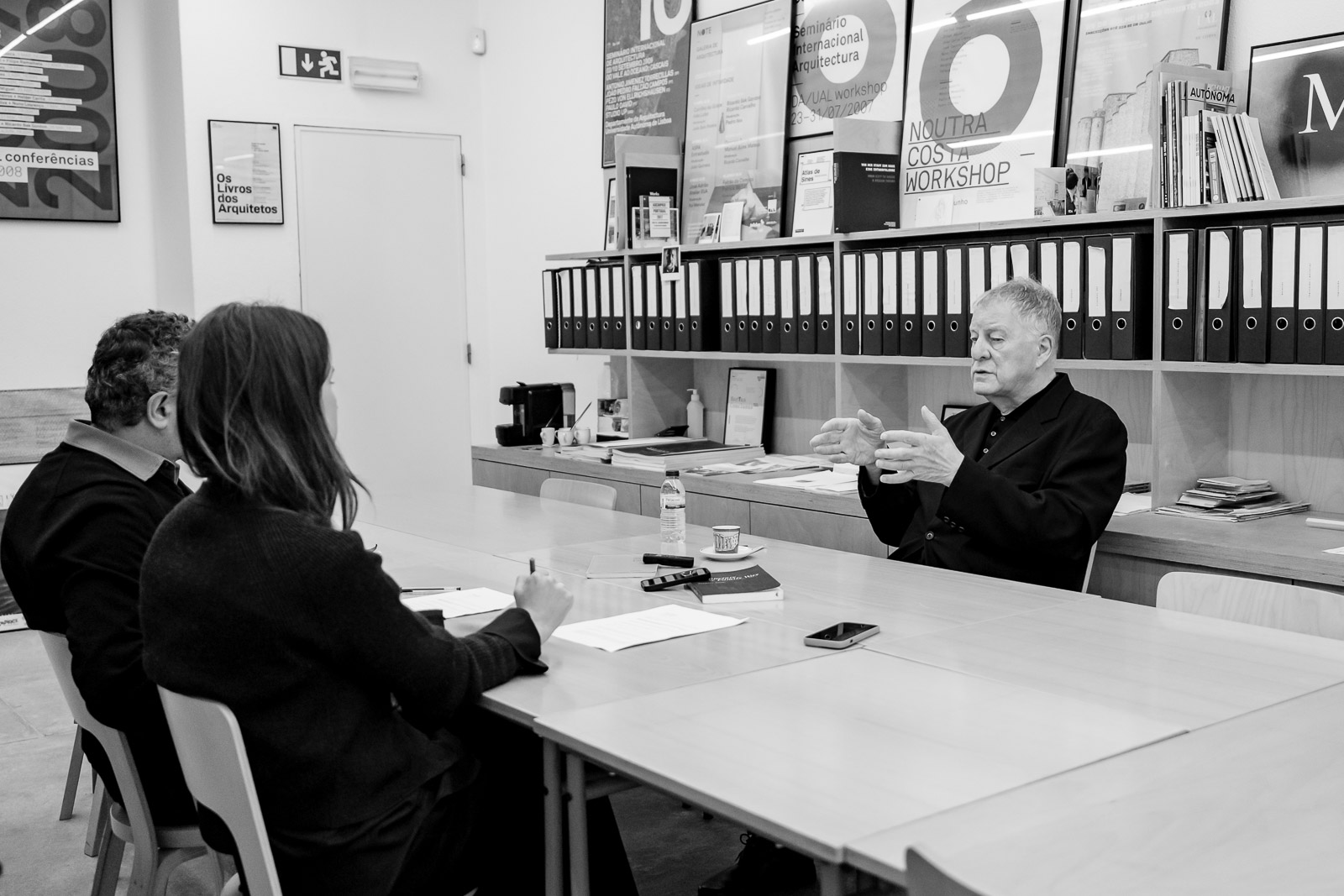
© Gonçalo Henriques + Estudo Prévio
You often mention that what initially drew you to architecture was its potential as a social art form — one that benefits people. Do you still regard architecture in that way?
Architecture can indeed be a social art, but this requires a cultivated acceptance of it within society. I have completed projects for excellent clients who later sold them to people of far less sensibility. Although those buildings are not physically in ruin, they have been, in a sense, ruined through misuse. I once believed that if I created architecture that spoke to people, they would naturally understand it. But they do not and that realisation has been revealing for me.
In the United Kingdom, we are increasingly confronted with a society that does not value its culture and social fabric, one that is interested solely in financial value. In such a context, good architecture only emerges when one has good clients. When we worked in the Netherlands, at the beginning of this century, the situation was far more progressive. Developers understood that architects had something valuable to contribute and were willing to wait until they encountered a scheme in which they genuinely believed. I am not sure that remains the case in the Netherlands today.
There are periods when it is easier to create architecture that functions as a social art and is recognised as such, and others when it becomes far more difficult. At present, I believe we are living through one of the more difficult periods.
In a way, if one looks at just two of your buildings — the Lisson Gallery and the Camden Arts Centre — they seem to have been well received by the public. They have endured over time and have established a dialogue between the people who live in those areas and the surrounding urban fabric.
That is largely due to the individuals who led those institutions. The director of the Lisson Gallery, who is now about to retire, possessed a strong sense of social responsibility, even though his was a commercial gallery. I recall that when the gallery first opened, he gave an impromptu speech about the social role of commercial galleries — something one would be unlikely to hear today. He genuinely believed in the role of art within society.
Similarly, the Camden Arts Centre was directed for thirty years by Jenny Lomax, who was exceptional. She managed to resist the pressures that have affected so many arts institutions in England today, where funding is continuously being cut. Her leadership preserved the Centre’s integrity and ensured that it remained engaged with both its community and the broader cultural sphere.
It is also interesting that both buildings are located in rather peripheral areas. The Lisson Gallery stands on Bell Street, just off Edgware Road — an unusually long and heavily trafficked thoroughfare — while the Camden Arts Centre is situated on Arkwright Road, off Finchley Road, part of the A41. Although neither site would ordinarily be considered a natural place for public gathering, the Camden Arts Centre has proved to be a remarkably successful building.
That success of the Camden Arts Centre is partly because the surrounding area lacked certain amenities. There was no park, no bookshop, and very few good restaurants, and the Camden Arts Centre began to provide what was missing. We created a garden at the back, which has since become a place where people come simply to relax. The Camden Arts Centre understood that part of its mission was to create a space where people could sit, write, or read. Very early on, they recognised that an art centre need not be concerned solely with art — it could also be about pleasure. All of the art centres we designed incorporated that principle. They brought a certain refinement, on several levels, to their respective localities.
For example, we designed one on the Isle of Wight — the Quay Arts Centre — which transformed its area. The restaurant there was partially subsidised, so it was not subject to the same commercial pressures; it did not have to cater to an unsophisticated local market and could therefore take risks. The directors of those institutions were remarkable individuals. In fact, all of my best clients have been women. Jenny Lomax, a formidable figure, served as Director of the Camden Arts Centre for thirty years. She was exceptionally generous and mentored a generation of young curators. On the Isle of Wight, the Quay Arts Centre was realised through the efforts of Anne Toms, a local painter who was instrumental in bringing it into being. In Denmark, at the Fuglsang Art Museum, it was Anne Høyer Petersen who played that role.
These were people whose ambitions were not personal but social. For such clients, one is willing to do anything — they did not make unreasonable demands, but they accepted and understood what we were trying to achieve. They were, without question, our greatest clients, and the projects we created for them have endured.
That said, even the Camden Arts Centre is now under pressure. We recently redesigned the shop to make it more commercial — it is now, essentially, a gift shop. It has had to become so, given the economic pressures placed on institutions today, even on those as prominent as the Tate.
You have often mentioned James Gowan as one of the teachers you most appreciated during your time at the AA. In your own teaching, do you feel there is an influence from Gowan’s methodology?
I believe there is. James Gowan, with James Stirling, had a remarkable early career. Together they designed the Leicester Engineering Building, after which they parted ways. Stirling went on to achieve considerable fame, while Gowan remained less well known, yet he was an exceptionally strong thinker.
Gowan’s approach to teaching was profoundly positive. I wrote the introduction to a book on him, which I titled Magnetic Fishing, and in it I explained that Gowan would accept virtually anything a student brought as a project proposal and demonstrate how it could become architecture. He could do this because he possessed a strong appreciation for chance, in much the same way as Marcel Duchamp, whose work he knew. His thinking extended far beyond conventional construction logic. He was deeply interested in how creative minds operate — in how mistakes can be revealing and productive. He focused on the individuality of each student’s work; even if a project was incoherent, he could discern its potential meaning. His great skill lay in fostering a student’s confidence and pleasure in making architecture. I did not know any other teacher quite like him. Other tutors were also good, of course, but they tended to teach what they already knew; they taught architecture in their own style.
In my own teaching, I try to remove stylistic direction as much as possible, which is more difficult than one might think. I focus on teaching the craft of design — on showing students that almost anything they draw can be developed into viable architecture. Schools of architecture often make students anxious about the perceived quality of their work. If something does not look right from the outset, they feel they have failed. I try to demonstrate what their schemes might become; as a result, they often change and evolve.
I believe that one must both educate and guide. At times, one even has to design parts of the project for them — which, in truth, students appreciate. When I began teaching at London Metropolitan University, I refused to direct students in that way. Several years later, they complained, saying, “You should have shown us how to do things.” And they were absolutely right. Students want to learn craft — they want to see design in action. So, I might say, “If you want my view, you could do it this way — but it’s your project.”
Teaching, for me, is therefore a kind of patchwork: respecting a student’s initial ideas and helping them develop those ideas quietly, without becoming the author of their work. One must steer the conversation in a certain direction, showing them relevant work by great architects that may resonate with what they are attempting, so that they can envision an end product embodying the potential you see in their scheme.
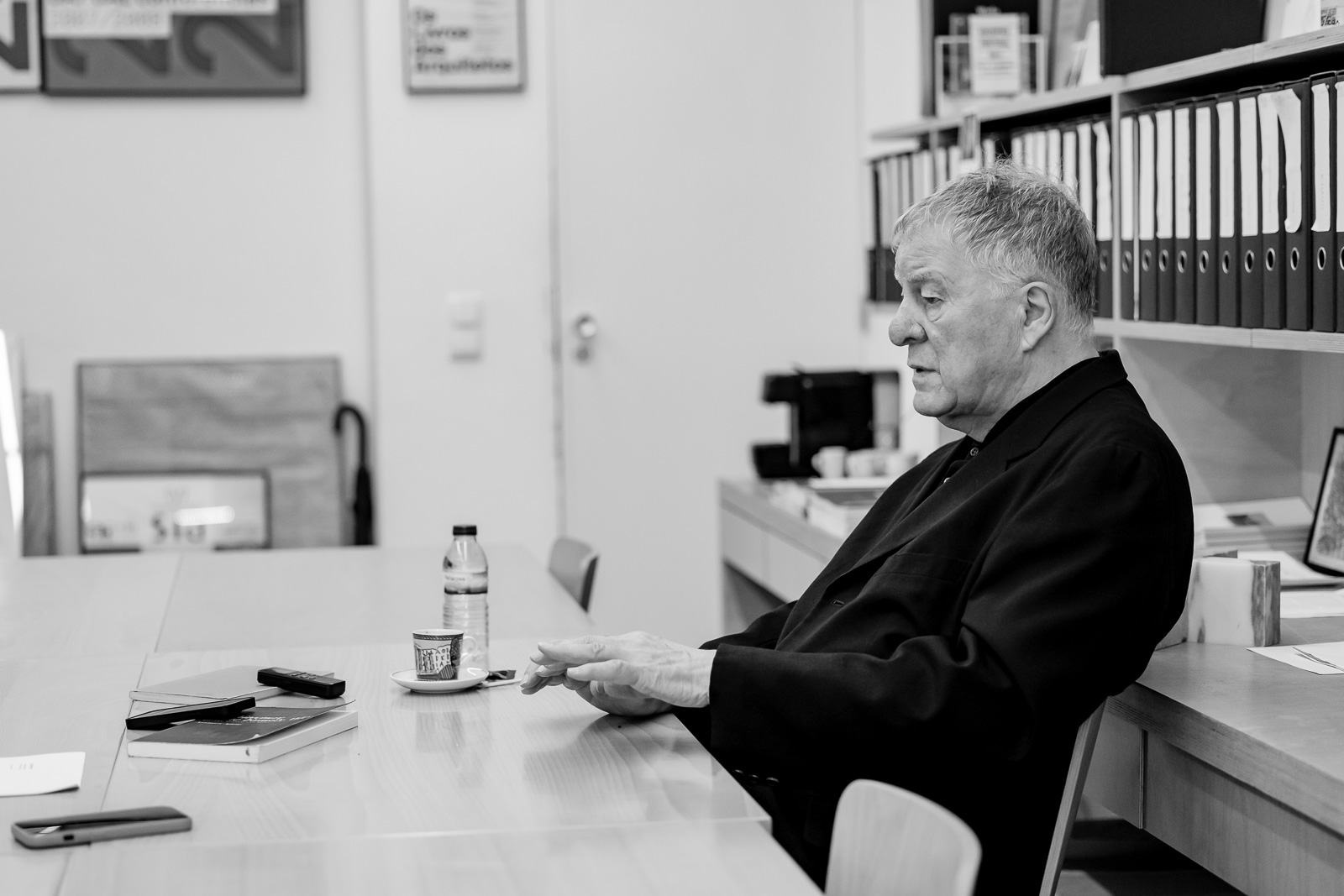
© Gonçalo Henriques + Estudo Prévio
It is interesting that you mention Gowan and use the term chance. You often refer to intuition yourself. In what ways do you and Gowan perceive the relationship between chance and intuition?
I believe that all creative practices rely heavily on intuitive skill. It is not irrational; rather, it is a method of accessing the most imaginative part of the mind. This approach is not unique to architects. For instance, Henry Ford, the founder of the Ford Motor Company, had a chair in his office that was comfortable but lacked a desk. He remarked that he did his best thinking while sitting there, without actively thinking about anything. Intuition, in this sense, is employed by entrepreneurs, scientists and actors. One begins with an idea that is alive and intuitive, and only afterwards works out how to realise it.
James Gowan maintained sketchbooks, some of which he showed me. He described the sketchbook as a space in which an architectural idea could be explored freely, prior to being built, approved by a client, or constrained by legislation. It is a way of engaging with architectural ideas in their purest form. I have never encountered anyone else who expressed such a perspective so clearly.
How do you foster or communicate that sense of intuition to your students?
I make my own intuition visible to them in practice. For example, I might say: even if you were to reconfigure the entire project, you could still retain the essential qualities you are pursuing — perhaps three specific tiles, or the aspiration for a building to have a particular height and presence. I may suggest elements that are not part of the original programme — for instance, studios facing north that would become the most beautiful spaces in the building — and show how a small adjustment, such as the placement of a lift, can unlock an unexpected potential.
In doing so, I aim to demonstrate adventure and courage in design. I want students to see that, as architects, they can imagine spaces that are truly wonderful, and that intuition is a legitimate and essential part of architectural thinking.
By posing questions, you open new possibilities.
I demonstrate my approach. I show students how my own creative and intuitive mind engages with their projects as an illustration of how one can think architecturally. In doing so, I reveal techniques that may not be immediately apparent to them — techniques that come from experience, from having studied and reflected on many buildings, and from having considered the principles of architecture in depth.
You have a responsibility to educate, which we find very admirable. It is particularly interesting that architects such as Jonathan Sergison and Stephen Bates cite you as a decisive influence on their development. There are few interviews in which you discuss your teaching approach — how you work with students to bring out their best. Could you explain how this process works, and how you feel about it?
I would largely reiterate what I have previously described. In addition, I would emphasise that if an architect produces work that people find compelling, students naturally want to learn from that person. The combination of active practice and teaching allows this dynamic to occur. Had I not built these projects, I might merely have been an interesting speaker — but there are many teachers who have never built anything and are nonetheless serious educators.
I was simultaneously practising architecture and teaching it, so students could see that the modes of thought I offered could lead to tangible results with a real effect on society. I was particularly close to the generation you mentioned, and in my own generation, I found few peers whose work I truly respected perhaps with the exception of David Chipperfield, who is about ten years younger than me. Consequently, the younger generation of Jonathan and Stephen was particularly stimulating to engage with, and this combination proved very positive for them.
London Metropolitan University seems to occupy a central position in this context, as you are now teaching there. In the late 1980s and early 1990s, the Architectural Research Unit (ARU), led by Florian Beigel and Philippe Christou, was also highly influential. Many of the current British practices cite the Half Moon Theatre and the Lisson Gallery as the most decisive projects from that period. This is particularly interesting because, from our perspective, both projects engage directly with the urban fabric—the Half Moon Theatre in the context of European urbanism.
The Half Moon Theatre was a remarkable building, and it is a great pity that it did not survive. Florian Beigel was an exceptionally interesting architect. Indeed, to revise what I said earlier, Florian and I were approximately the same age, and we were two of the figures in that generation who were particularly significant. In that period, we were two active players. I was perhaps more open and had more collaborators willing to explore the ideas I proposed. Florian was, in some respects, more restrictive, but he was nonetheless a very stimulating teacher.
I recall that, many years ago, when he was teaching part-time students at London Metropolitan — then known as North London Polytechnic — he provided an extraordinary level of cultural and architectural education to part-time, often working-class students. His teaching was highly cultivated and engaged, offering students access to architectural ideas in a manner that was both profound and inspiring. He was, without question, a great and influential educator.
You have noted that architectural practice has become increasingly complex in recent years. Given these circumstances, do you still feel optimistic about the profession’s future direction?
I have ceased practising, and I do not believe I could practise as effectively in the current context as I did thirty years ago. Friends of mine, now in their mid-fifties and working in social housing, often find themselves treated with little respect by their clients. Their optimism about architecture and its social potential is maintained entirely on their own, without support from local authorities. I anticipate that, perhaps in five to ten years, some of these architects may simply retire, resulting in the loss of a generation of exceptionally talented practitioners. They are not and do not wish to be star architects, but just to be good and they are vital to the fabric of Britain.
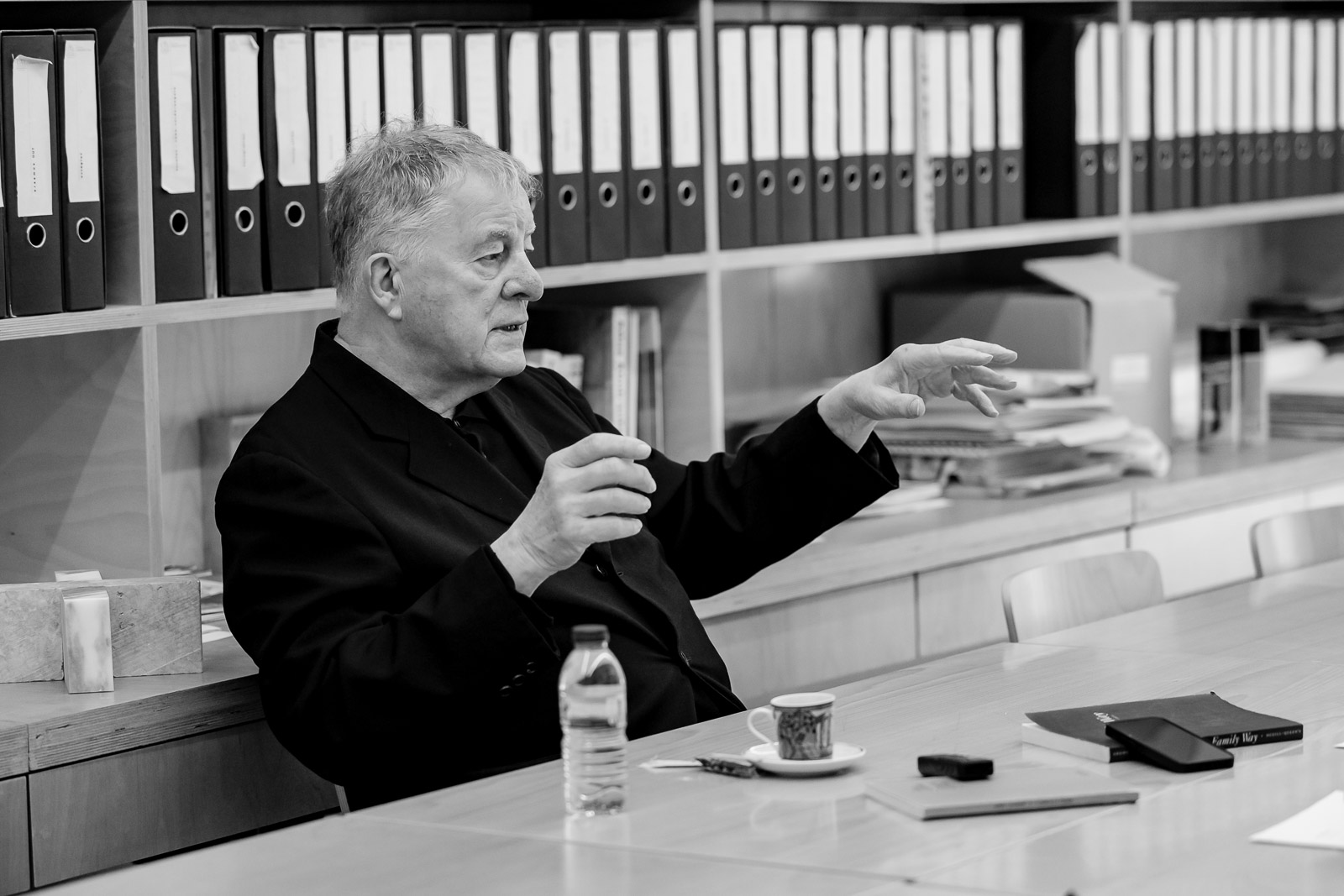
© Gonçalo Henriques + Estudo Prévio
© Gonçalo Henriques + Estudo Prévio
Architectural practice now requires cultivated clientele, yet the contemporary world is increasingly dominated by financial concerns and a pervasive mediocrity. Those who operate in this environment rarely appreciate cultivated architecture; they equate practicality with cheapness, a mindset that produces social consequences lasting for decades. Dealing with such clients is exceptionally challenging, and under these conditions, it is understandable to feel less optimistic than in the past.
Success in that context requires a nuanced understanding of clients’ behaviours and expectations. One must carefully navigate their rules, adopt a measured position, and persuade subtly without overt explanation; otherwise, one risks losing the project. The work demands both strategic acumen and patience.
We are intrigued to learn that, in your teaching at London Metropolitan University physical models are no longer a requirement. Instead, students now develop digital models, which you then guide and refine with them throughout the design process.
When building a physical model, one is immediately confronted with a choice: either retain it or dispose of it at the conclusion of the project. Students frequently discard their models, often due to limited storage space. The waste of material is great. Consequently, we decided to prioritise three-dimensional digital models, which offer far greater insight into a design. While physical models reveal certain aspects, digital models allow for a more comprehensive understanding.
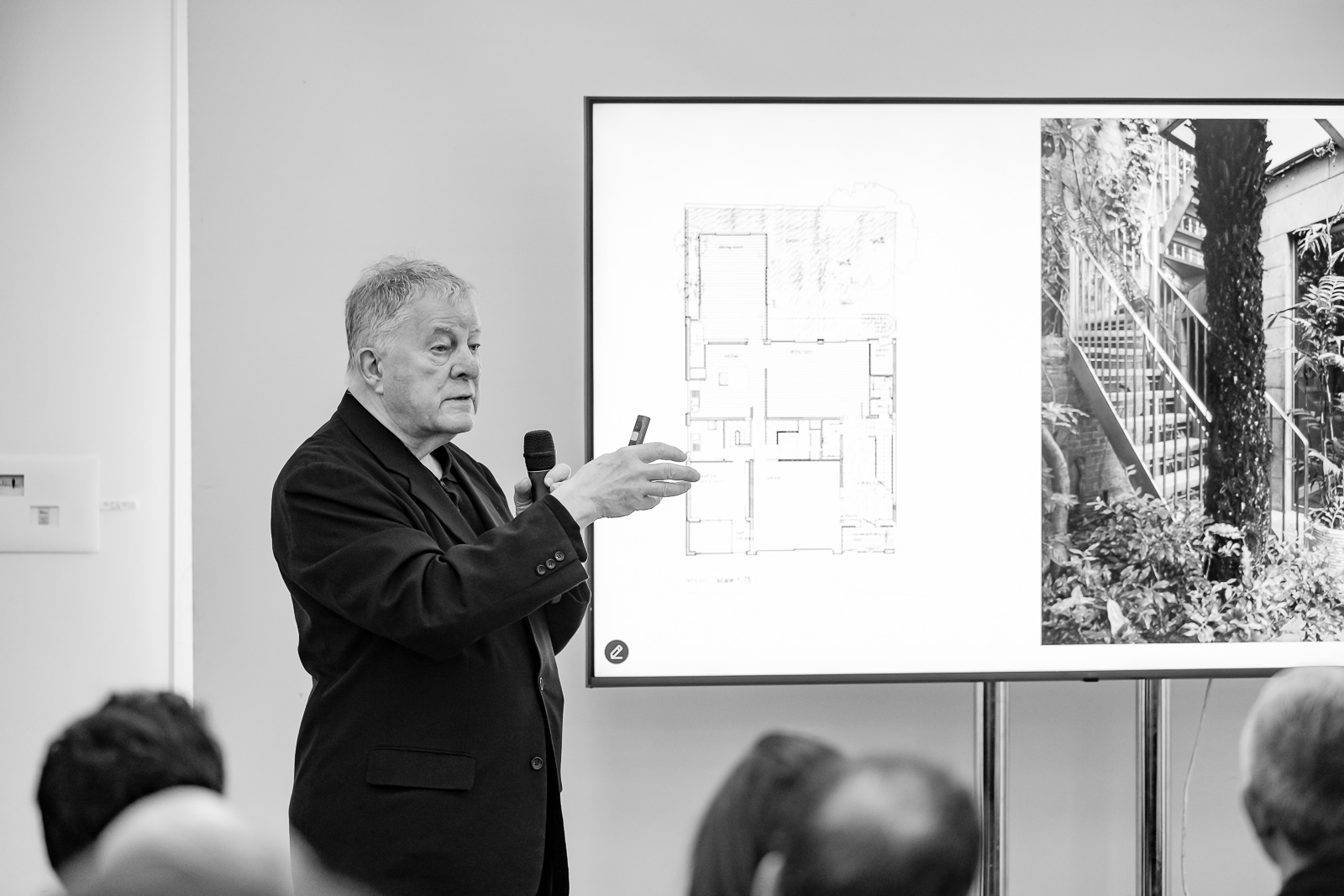
I recall taking my students to Philadelphia to visit the Louis Kahn archive. The curator presented a section and began explaining the architecture, but we struggled to grasp the ideas from his discussion of the conventional two-dimensional representations. Historically, when presenting to clients, architects would rely on plans and verbal descriptions — “this room will be wonderful; the ceiling will be like that” — which often left clients puzzled or uncertain. Digital renderings, by contrast, convey spatial and experiential qualities more directly, allowing one to illustrate precisely what the building will achieve. I consider this approach both more humane and more professional.
In teaching, I encourage students to explore their 3D models dynamically: to view the building from across the park, to look through its windows back onto the surrounding environment, or to generate aerial views that represent the project floor by floor. Our instruction extends beyond modelling to portfolio development and presentation skills. I advise students to begin with the completed building and work backwards to analyse the design intent, process, and effects. Three-dimensional digital drawing facilitates this exploration.
I have long been convinced of the value of CAD. In the early stages of my practice, I frequently sketched using a CAD program, attracted by its portability and ease of storage. I donated my hand-drawn sketchbooks to the Victoria and Albert Museum, yet the sheer volume underscored the limitations of physical media. While there remains an immediacy and tactile quality to drawing by hand that digital tools cannot entirely replicate, I have committed to exploring digital techniques over many years. Digital models are easily stored, shared, and refined, addressing both practical and pedagogical challenges in contemporary architectural education.
© Gonçalo Henriques + Estudo Prévio
Agradecimentos
Ricardo Aboim Inglez agradece o apoio concedido pela Fundação para a Ciência e Tecnologia (FCT) através da Bolsa de Doutoramento 2025.05511.BD